medtronic LABS X PARALLEL HQ
How we replaced an 18-month engineering process with a chat conversation.
ROLE
Product Design
Strategy
Pitch Deck
TIMELINE
August 2026
(2 weeks)
TEAM
Project Lead
2 Product Designers
tools
Figma
Claude
Figma Make
Overview
When a healthcare guideline changes, it triggers a sequential pipeline - Digital Adaptation Kit creation (12 months), followed by custom engineering (6+ months) before any health worker can act on it.
Our stakeholders needed a way to cut that down dramatically, without requiring a full fledged development team in the loop.

SOLUTION
The target user is a clinical author or Ministry of Health implementation specialist. They are domain experts, deeply knowledgeable about health policy, clinical protocols, and national health systems. They are not product people, and they are not engineers. Asking them to learn a new piece of software on top of an already complex job is a real cost.
This tool lets clinical authors and Ministry of Health implementers describe a healthcare workflow in plain language. The AI agent, Vera asks clarifying questions, proposes a structured workflow, and builds it on a visual canvas. No engineering required.

The Pivot
The initial direction from the client was a block-based drag-and-drop workflow builder, users would construct workflows by placing and connecting pre-built blocks on a canvas. Each block representing a step, condition, or data field. Structured, configurable, and entirely user-driven.
Days 1–5 went into context gathering and building the first cut. Alongside the block-based screens, we ran quick informal tests with people around us to see how intuitive the system actually felt. The pattern was clear: block-based thinking assumes users already understand workflow logic, steps, conditions, branches, and our actual users wouldn't.
So we pitched a different direction: we pitched a small AI copilot demo to show what that could look like along with a block based approach that they wanted us to follow. The stakeholders were impressed enough that they greenlit an AI-first approach for the entire product.
The block-based approach required users to learn the system.
The AI-first approach made the system learn the user.

Before : Block Based Approach


No prior references
Nothing like Spice exists in healthcare. We couldn’t benchmark against a competitor or adapt an existing pattern, every decision was made from scratch.
No real users
With a proof of concept at this stage, there were no actual clinical authors or MoH implementers to test with. Office testing was our only feedback loop.
Design system: partially built
1.5 weeks, post-pivot
The AI-first redesign happened with one week three days left on the clock.
AI Conversation Flow
Owning the AI conversation flow along with the demo pitch storyline
My specific scope: how Vera AI interacts with the user from first prompt to finished workflow - the conversation logic, the confirmation steps, from the moment the canvas comes alive till the time the user talks to Vera.
I also engineered the demo narrative. This was a proof of concept for international government pitches, so the screens needed to tell a complete, credible story. The persona: Dr. Grace Kwizera, Clinical Author at Rwanda's Ministry of Health, implementing a new Hypertension & Diabetes guideline nationally.

The AI-first pivot made the entire problem of onboarding or understanding the tool disappear. When Vera is doing the building, the user doesn't need to understand the canvas- they just need to answer questions they already know the answers to. The education layer wasn't simplified. It was eliminated.
Step 1 : Open prompt
User describes what they want to build in plain language and attaches the relevant guideline document.

Step 2 : Vera clarifies
Before generating anything, Vera summarises its understanding and asks targeted follow-up questions: country, health systems, user roles. Quick-select chips keep it fast.

Step 3 : Vera proposes a plan
A human-readable step-by-step workflow summary, with each block tagged to the relevant health system. User confirms or edits before anything is built.

Step 4 : Canvas builds automatically
Vera works, the workflow appears live on the canvas. The AI Chat panel and visual canvas are side by side throughout.
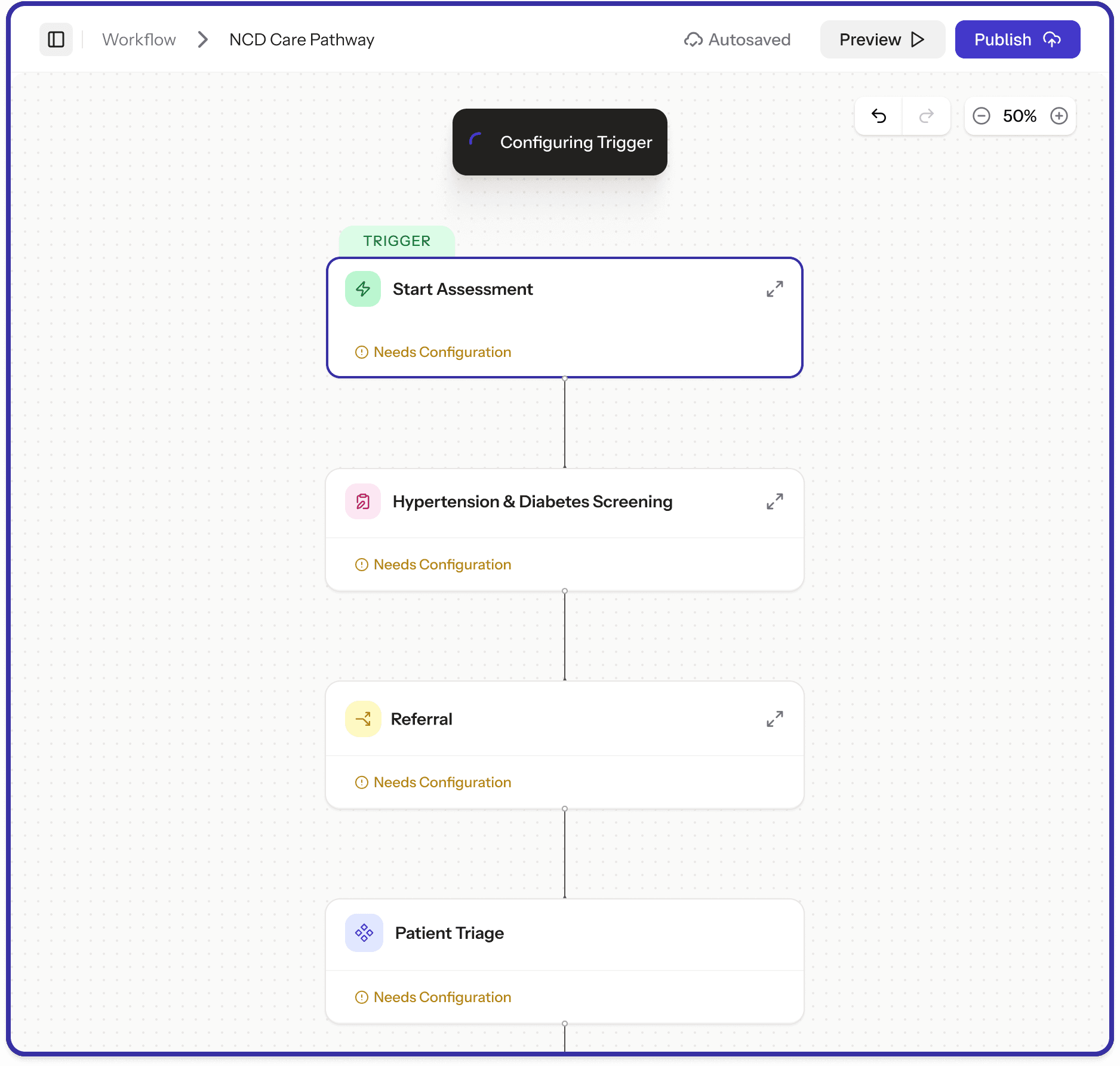
Step 5 : Block-by-block configuration
Vera walks through each block, proposes data fields based on the guideline, and confirms before applying. The user stays in control of every decision.

Step 6 : Manual override
If needed, the user can step out of the conversation entirely and configure or rearrange blocks on the canvas manually. Drag, drop, edit. The AI builds the foundation; the user has full control to adjust it.

Core Design Challenge
Building trust in an AI making clinical decisions
The users are not product people, they're health policy experts. The block-based approach required them to learn new software. The AI-first approach removed that barrier, but introduced a different one:
how do you make a non-technical user trust an AI that's structuring something as consequential as a national health protocol?

Work in Progress : Building the AI script

Outcome
The proof of concept was presented at an international level. It was acknowledged and well received, moving the conversation forward toward a national health system rollout.
Aarushi Bhalla · Associate Product Designer · Medtronic Labs · 2026