
Aarushi Bhalla

Product Designer

Aarushi Bhalla

Product Designer

enuff

An approachable solution for
Finding the ‘Enough for your Stuff’

An approachable solution for
Finding the ‘Enough for your Stuff’

AIM & ROLE

This 3 project was part of my Undergrad Thesis, aimed at addressing the issue of hyper-consumption by developing an accessible solution for users.


As an independent endeavour, I took on multiple roles throughout the process, including research, user testing, UX design, UI system design, business and system design, and even branding.

PROJECT OVERVIEW

In a world overflowing with brands and marketing messages telling us to buy, buy, buy, it’s easy to equate happiness with having more stuff.


This project dared to challenge the idea that “More things = More happiness” and instead explores the concept of “Enough” as the secret to genuine fulfilment.

Before I begin to explain my process...

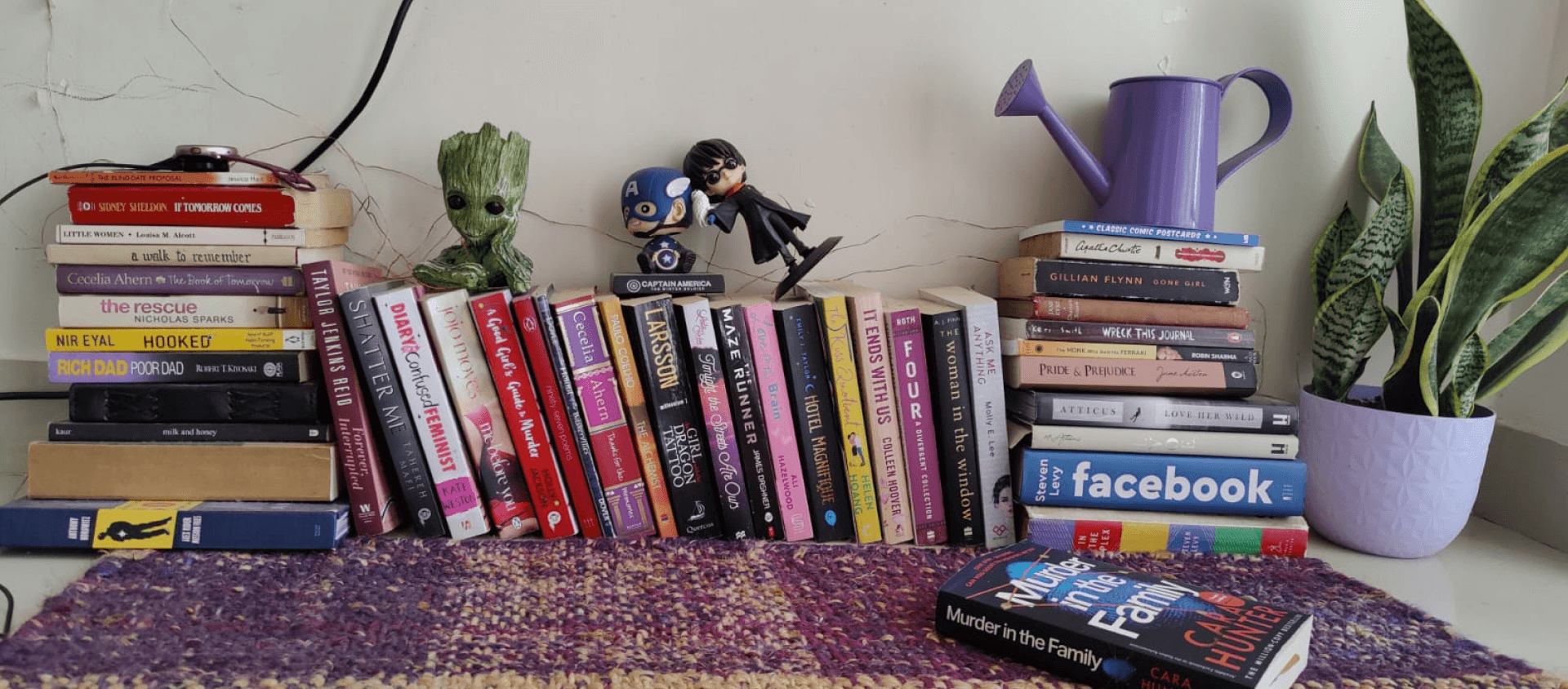
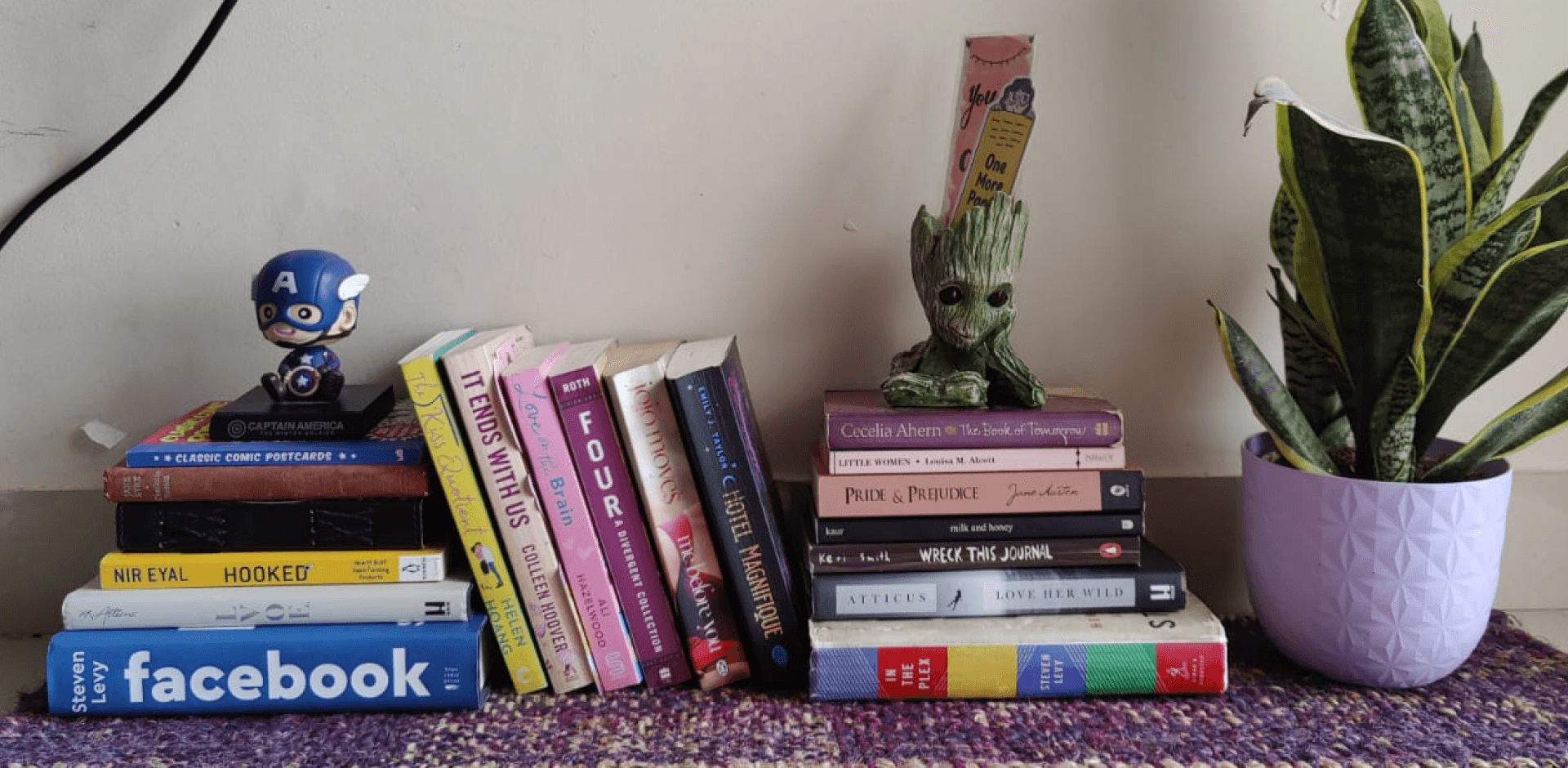
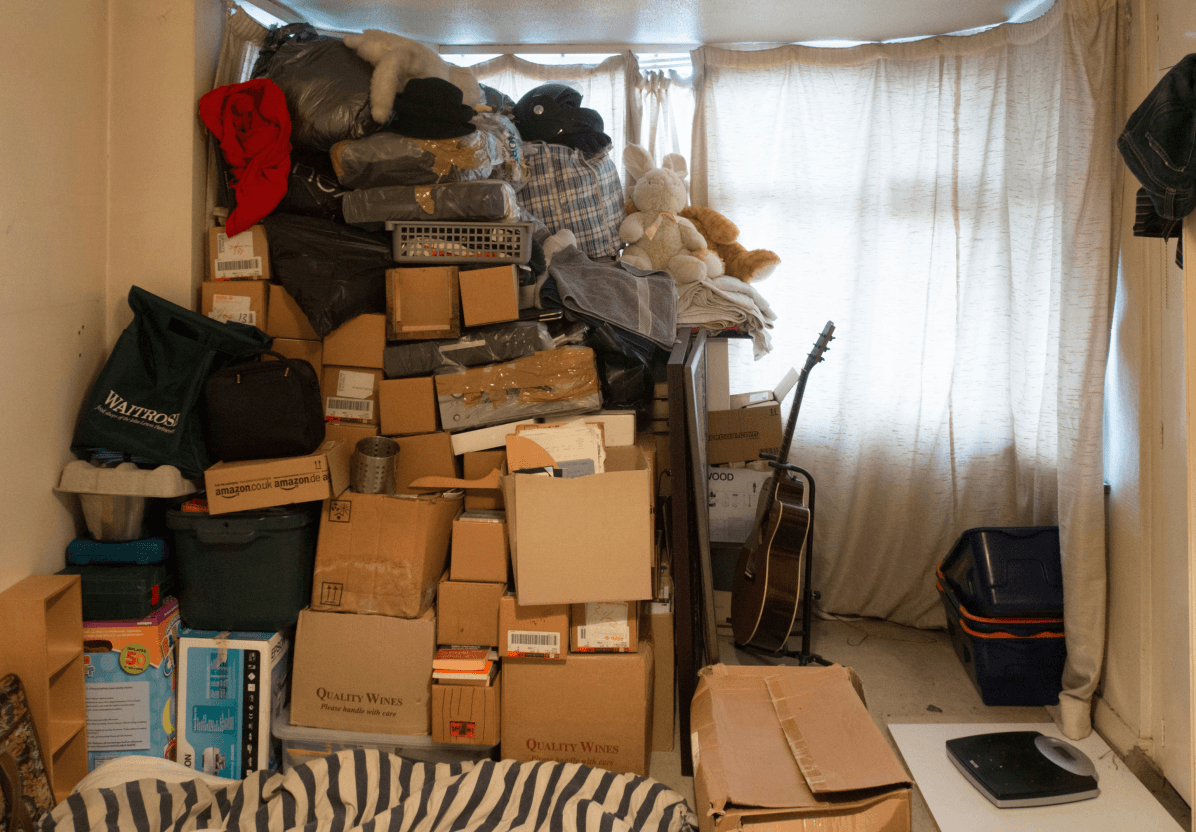
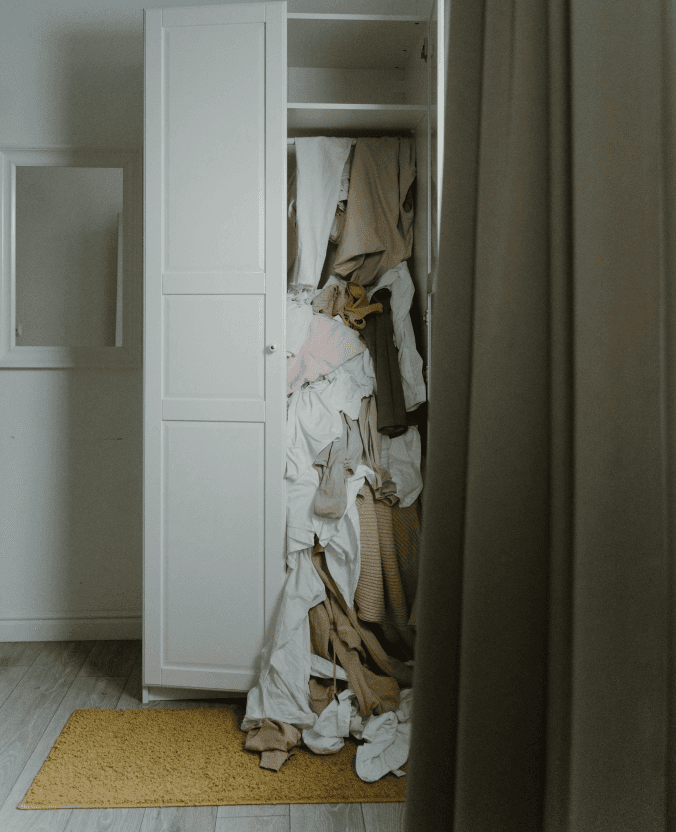
Relatable much?

Is this also how your house looks?
(Don’t be embarrassed, because me too!)


As they say, acceptance is the first step to change. And now that we somewhere accept the problem, let me walk you through my attempt to solve it. PS. Do read along till the end, it’s worth it, I promise 🤞

It began with Hyper Consumerism

The problem statement stems from the extreme hyper consumerism that prevails in the Indian society.

Hyper consumerism (noun)
the consumption of goods beyond one's necessities.

How do we address the problem of consuming more than we require?

How might we impact consumption patterns?

How might we create impact through nudging our consumers?

How might we empower a change in behaviour?

And I started reading

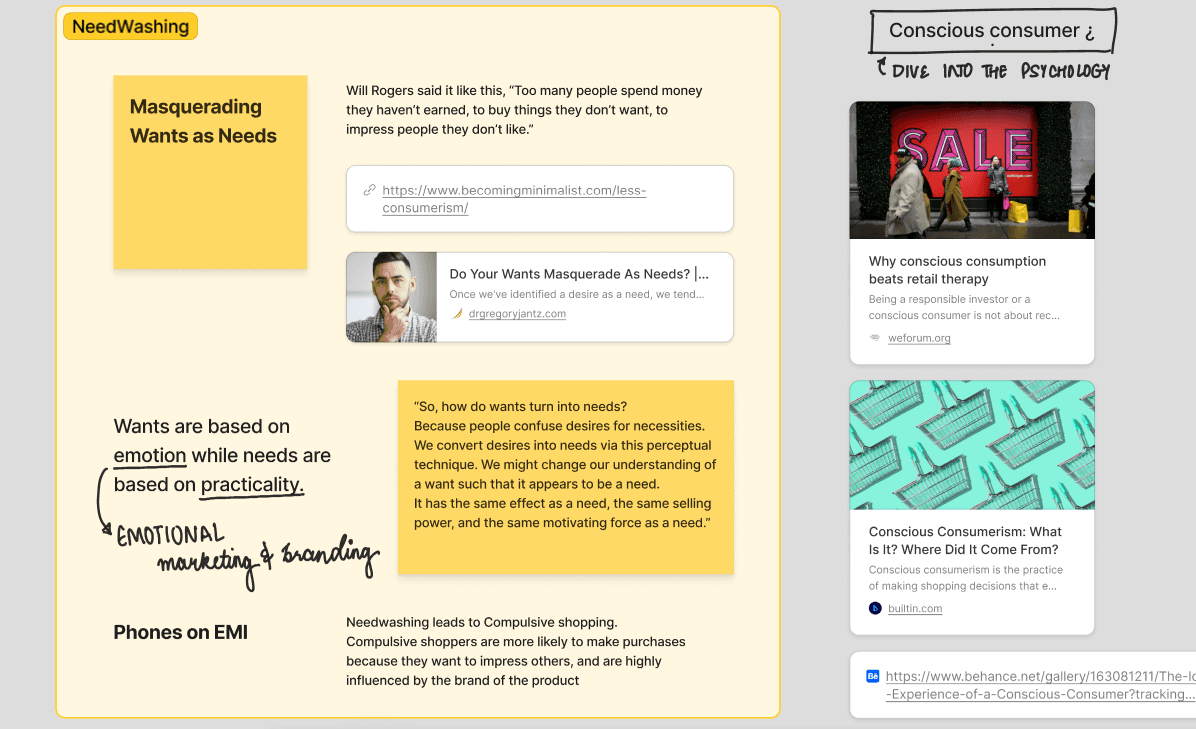
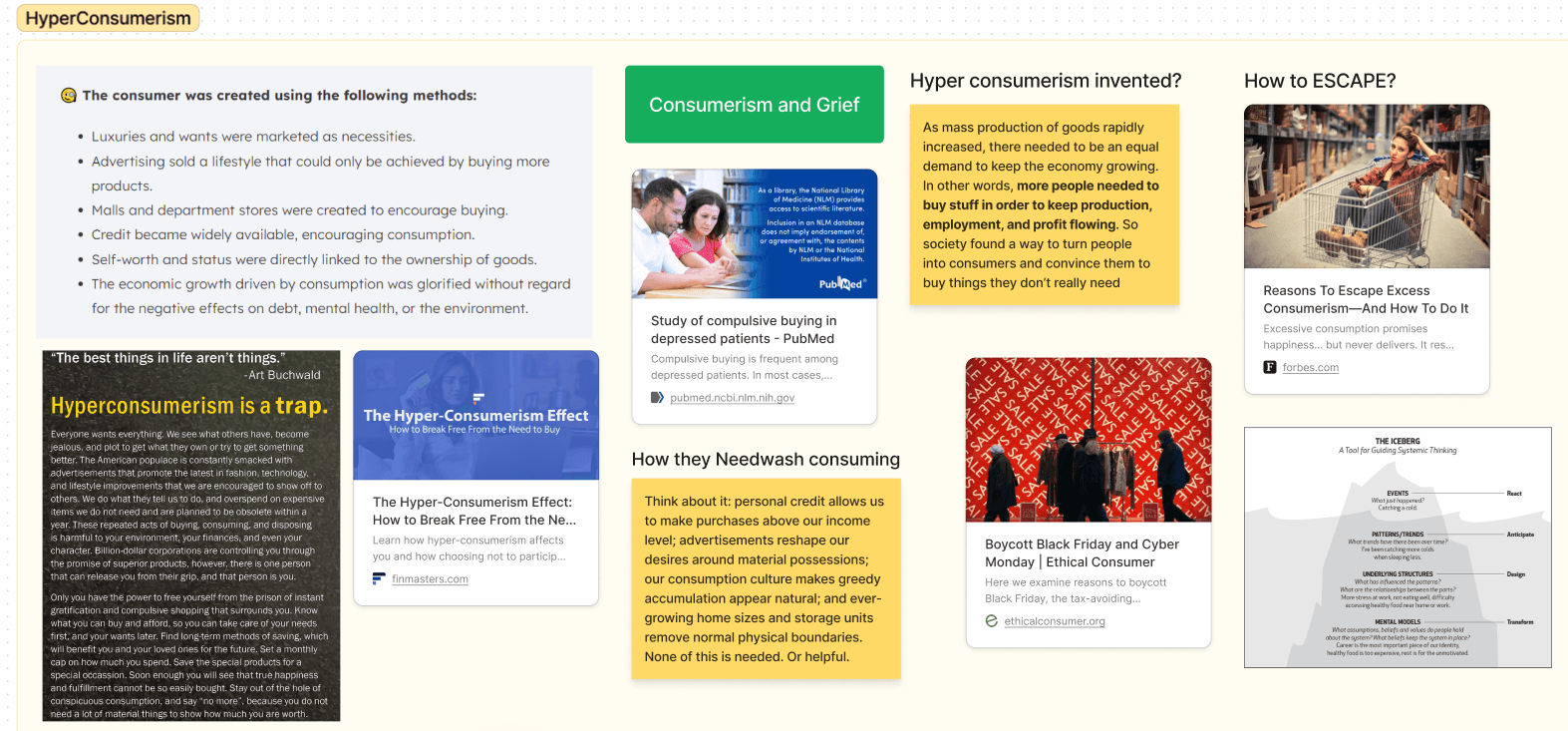
I began by reading research papers, articles and Ted talks about conscious consumerism. 7 days of scrambling through literature- shockingly I couldn’t find one single relevant Indian article. That’s when I knew this was an awareness battle (and a long one too)


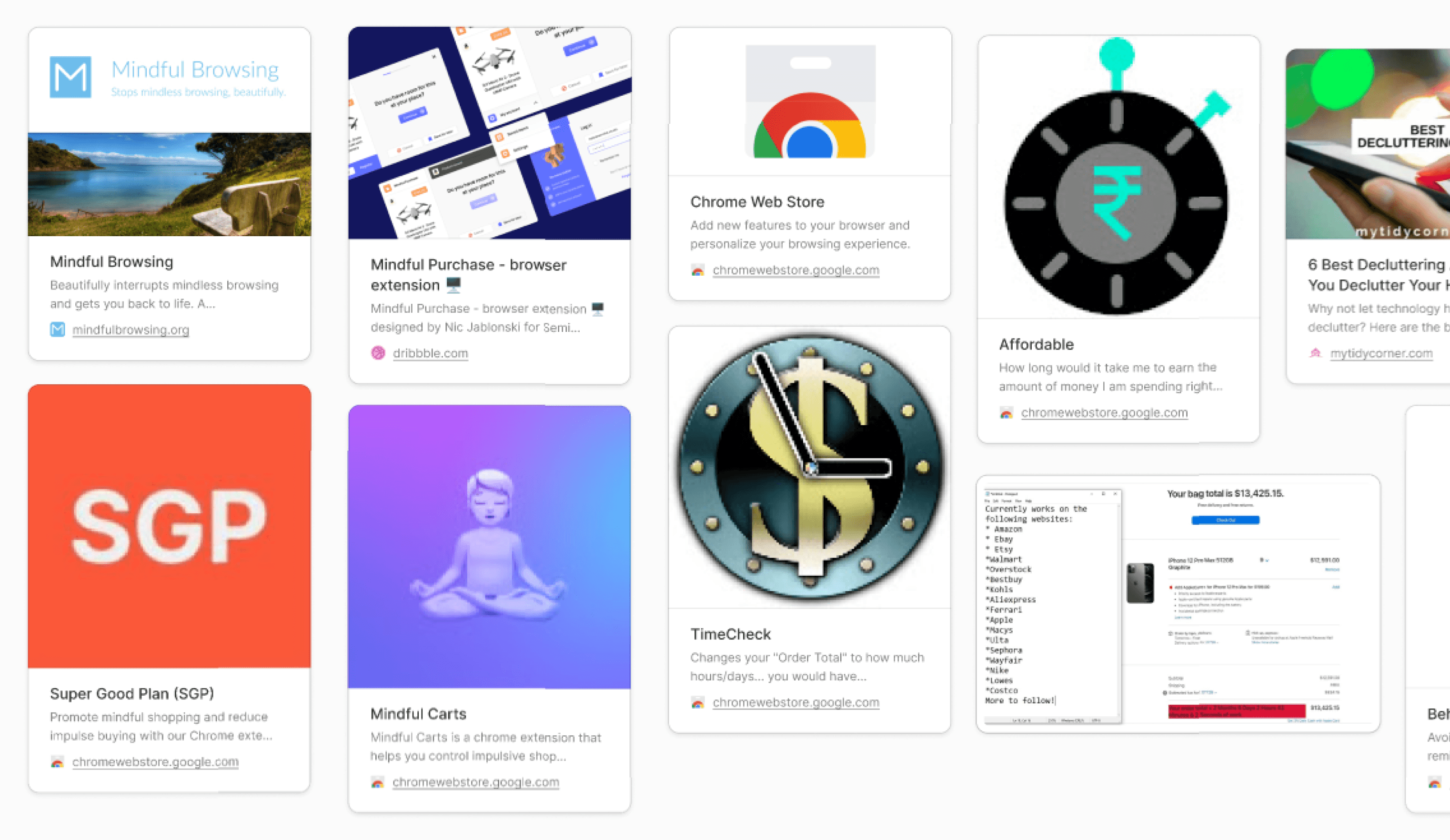
As soon as I fixated on finding a cure to hyper consumption, I also attempted to find existing solutions.  I came across things like the Hyper consumption Trap, the Consumerism Effect, Retail Therapy, etc.

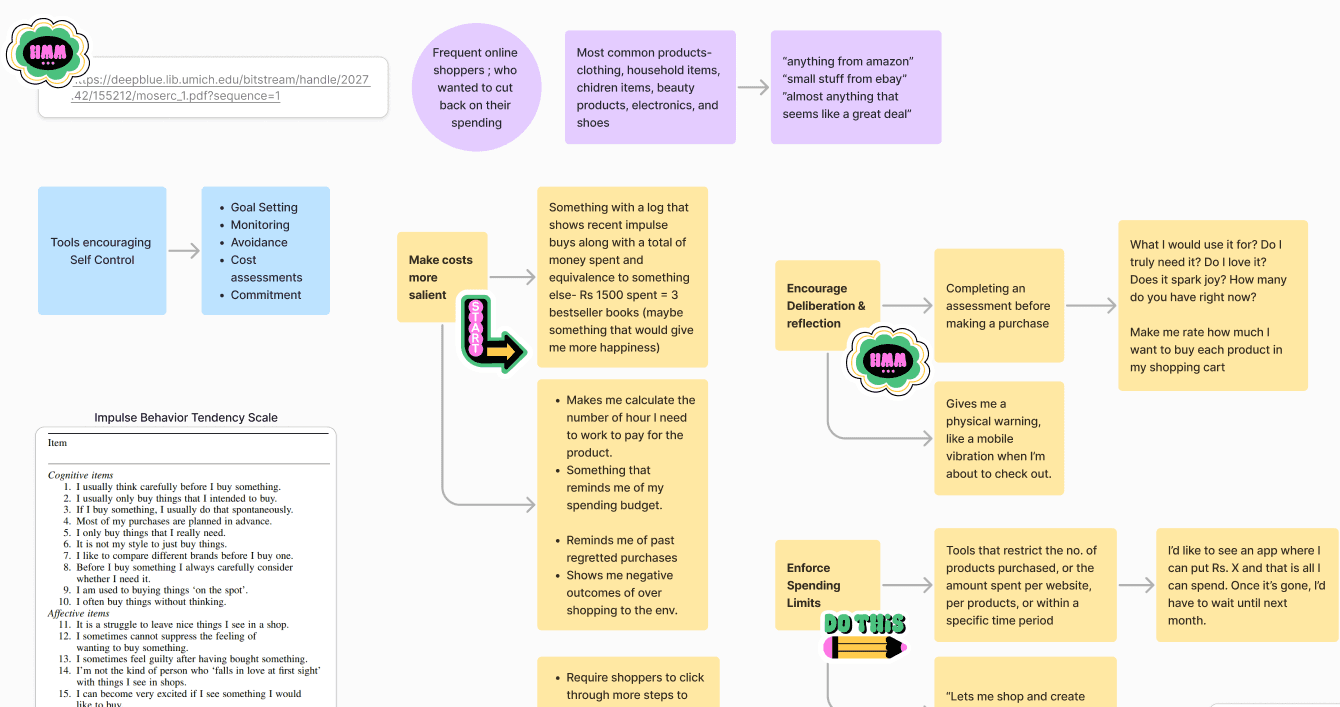
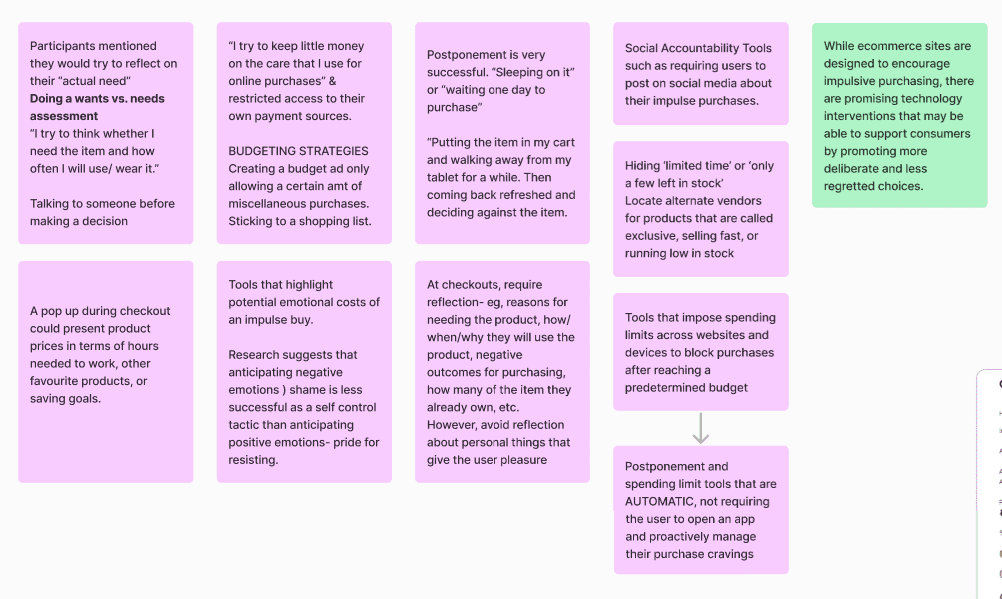
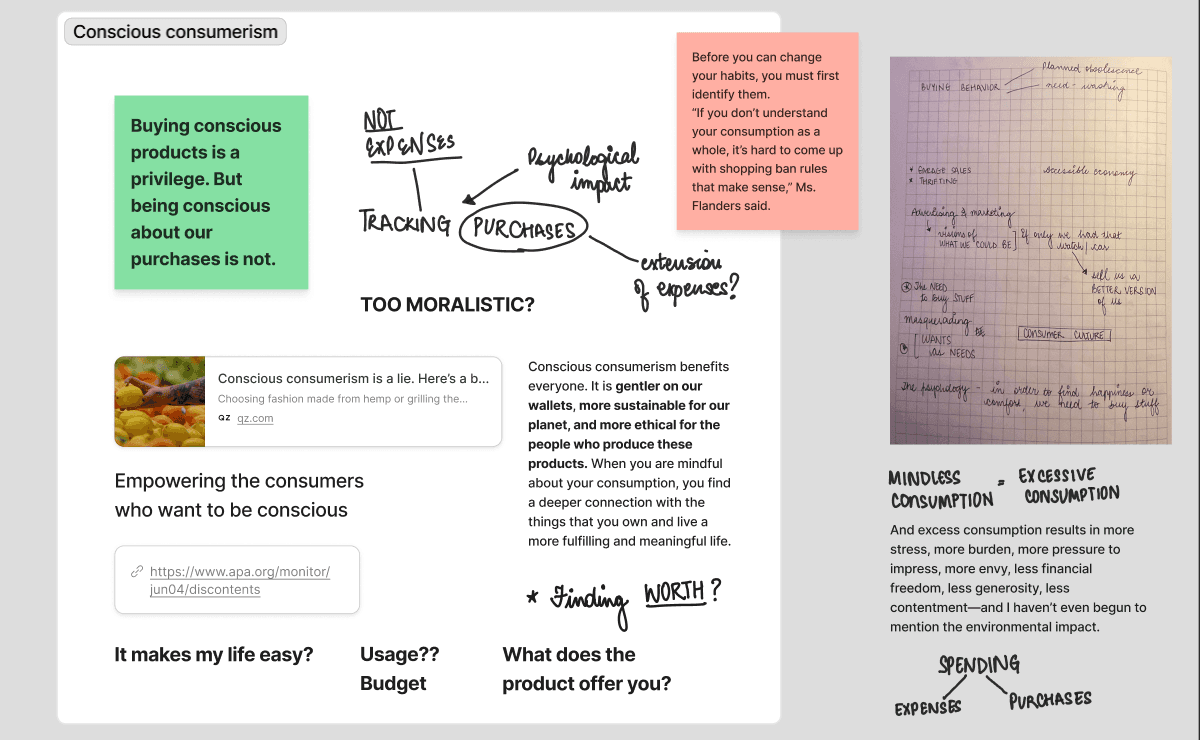
Here are some snapshots from my research board. If you want to gain access to my entire board and my journey, just send me a mail :)

Getting the breakthrough

After weeks of mind maps and research, I came across something that we never do- track our purchases.


We don’t know what we’re buying, let alone how much we’re buying. This irresponsibility and the lack of awareness is an indefinite cycle that builds this behaviour over time.

💡 Research Insight


No budget tracker ever categorises necessary expenses vs. purchases. Users mostly create categories manually. As a result, a user is never aware of what and how much they’re really buying.

Phase I of Primary Research

For my first round of interviews, I asked 6-10 people questions loosely relating to topics around my centre of enquiry

🛍️ Shopping behaviours

😵 Dark Marketing Patterns

🛒 Buying psychology

🧠 Conscious Consumption

🖋️ Tracking Expenses

📦 Decluttering

The biggest hurdle I faced was diplomatic answers. People subconsciously always come to defend their behaviour to an interviewer. Most people aren’t even aware of their own habits, how could I expect them to be vocal about them? Hence, I also decided to use observation along with conversation.

💡 The Guilt Trip Insight


A lot of people admitted that they don’t actually want to track their purchases simply because they feel guilty about buying things then.


They also don’t want to install a separate app to just track their purchases. Tracking takes time and effort, most importantly- commitment.

Not a strict, blaming intervention

People often dislike criticism and tend to avoid it. Users don’t need harsh feedback or blame, especially when dealing with a new and unfamiliar concept.

Therefore, I chose to develop and present my idea using the
Caregiver-Sage archetype. This approach focuses on assisting the user while delivering the harsh truth without any criticism.

🔍 Know your consumption patterns, behaviours and soft spots

📓 Making tracking a pleasurable nice guilt-free experience top layer

Existing solutions around Hyper Consumerism

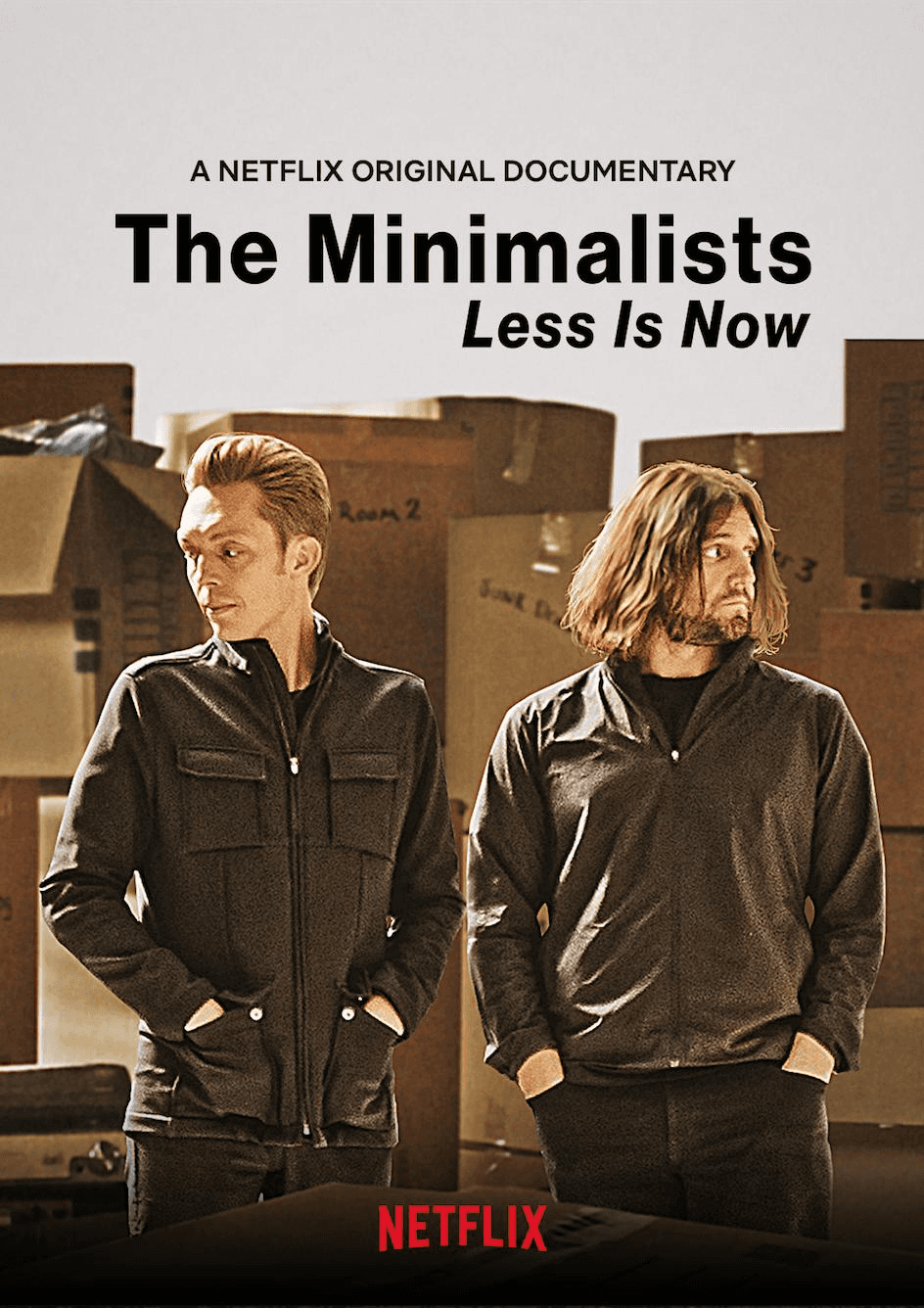
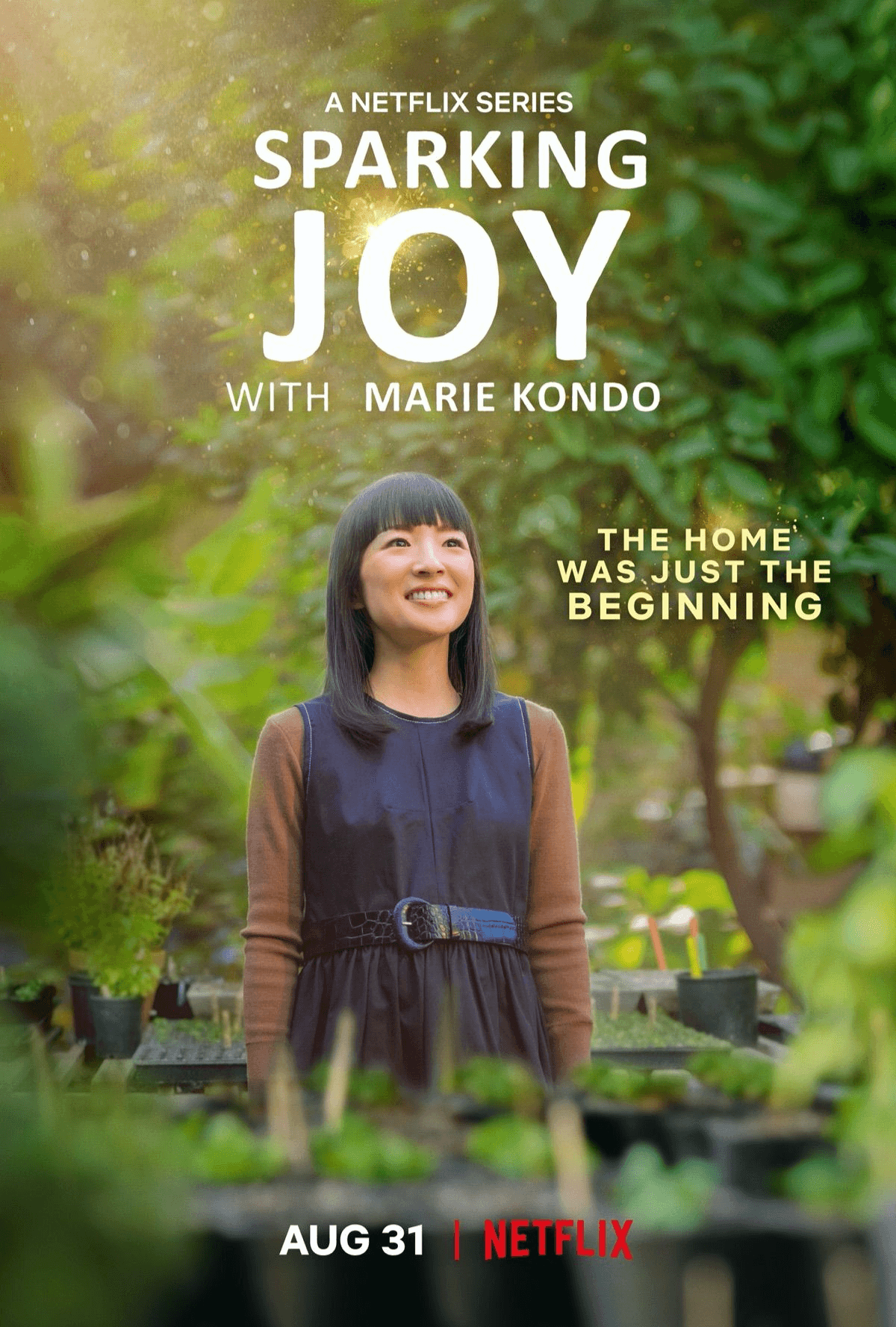
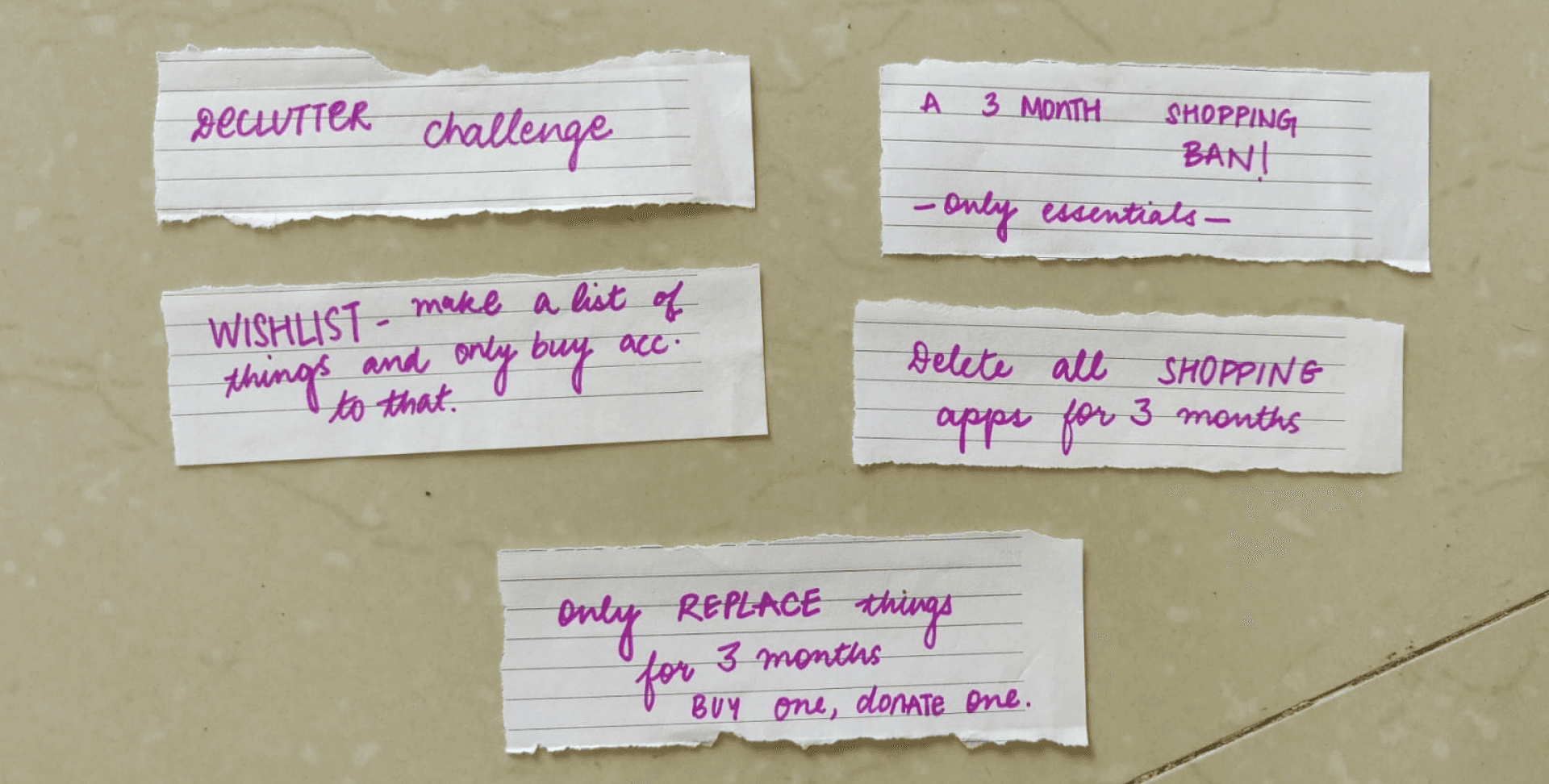
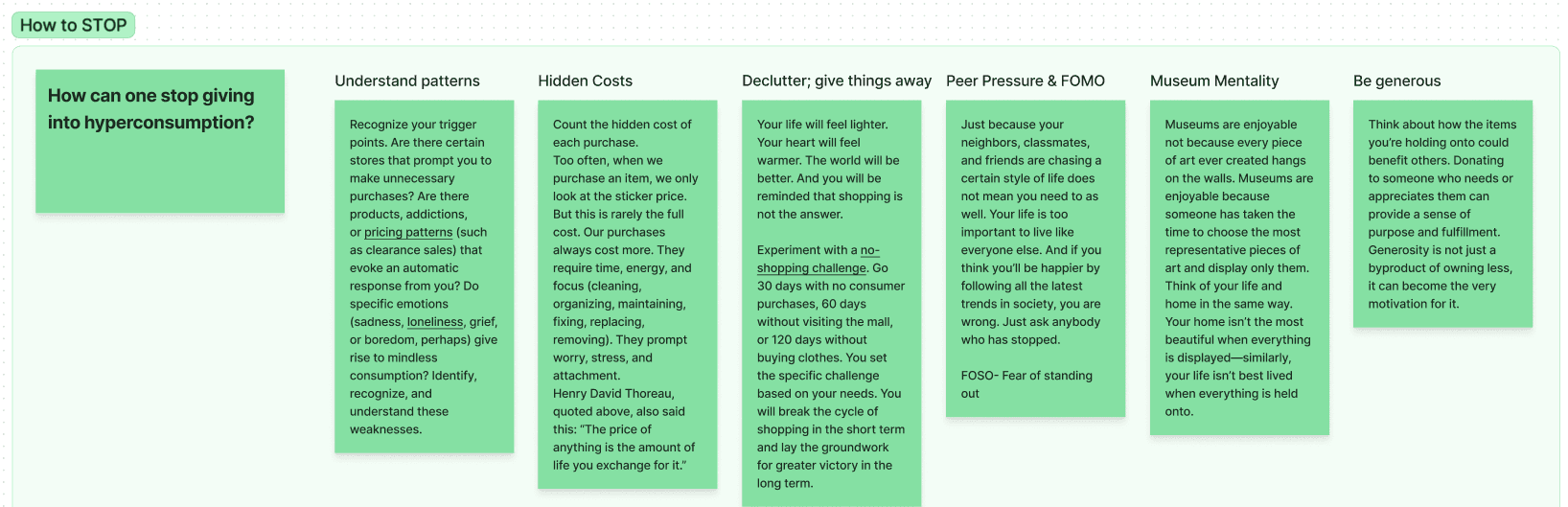
I came across a lot of people attempting to spread awareness. The most common ones being a ‘shopping ban’ trying to cut down on expenses as well as purchases, or a ‘decluttering challenge’ where you begin removing unnecessary things in your life.


Taking inspiration from ‘Not Buying It’ by Judith Levine, ‘The year of less’ by Cait Flanders and so many more, I decided to create impact.


‘How to push people to do it though?’

📋 The Wishlist Idea


Create a weekly or monthly list with three categories: Need to Buy, Want to Buy, and Might Buy. Note down impulse wants to reconsider in the next cycle, helping to avoid impulse purchases.

A Focus Group Discussion
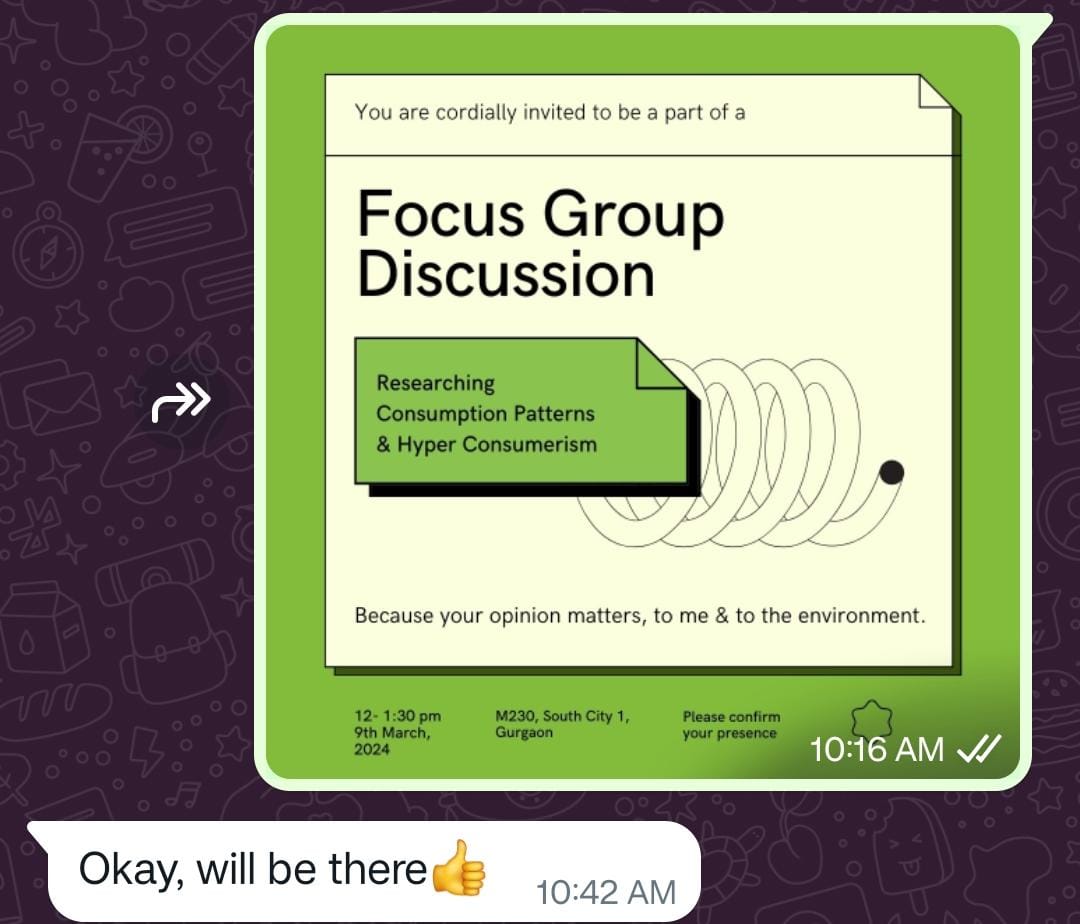
Following this, I held a focus group discussion with three people to open up dialogue around my thoughts and ideas. We had a lively conversation where we talked about buying behaviours, self awareness, impulse buying and marketing tactics. We also came across the ‘minimalist lifestyle’ and conscious buying habits. 


Decluttering was a newer topic for most of them and they hadn’t ever intentionally decluttered. There were circumstances where they had to, like moving to a new city.


Two of them agreed that they buy a lot more than they need and they would want to change this situation.

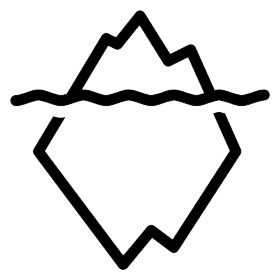
💡 Tip of the Iceberg


Unless people are conscious of what they own, they cannot be conscious of what they’re buying. Because another drop in the flood is of no importance until the water level is being dealt with.

I realized that ‘Buying too much’ is the smaller issue

“I own too many things”

“I buy too many things”
Minimalism ; the need to unpackage

People relate ‘buying less’ or ‘owing less’ straight to living a minimalist life. Although it sounds like a beautiful modern concept, it has been quite misunderstood. Following which, media and preconceived notions manage to scare most people away even before hearing or trying it out.

Minimalism

Minimalism

?

?

Consumerism

Consumerism

💡 The Minimalism Insight


People run away from minimalism because they have a preconceived notion of it which is extreme and scary. It sounds like a foreign concept, away from the way we were brought up. I needed to unpackage minimalism and present my ideologies in a different way.

Sorting the Cards

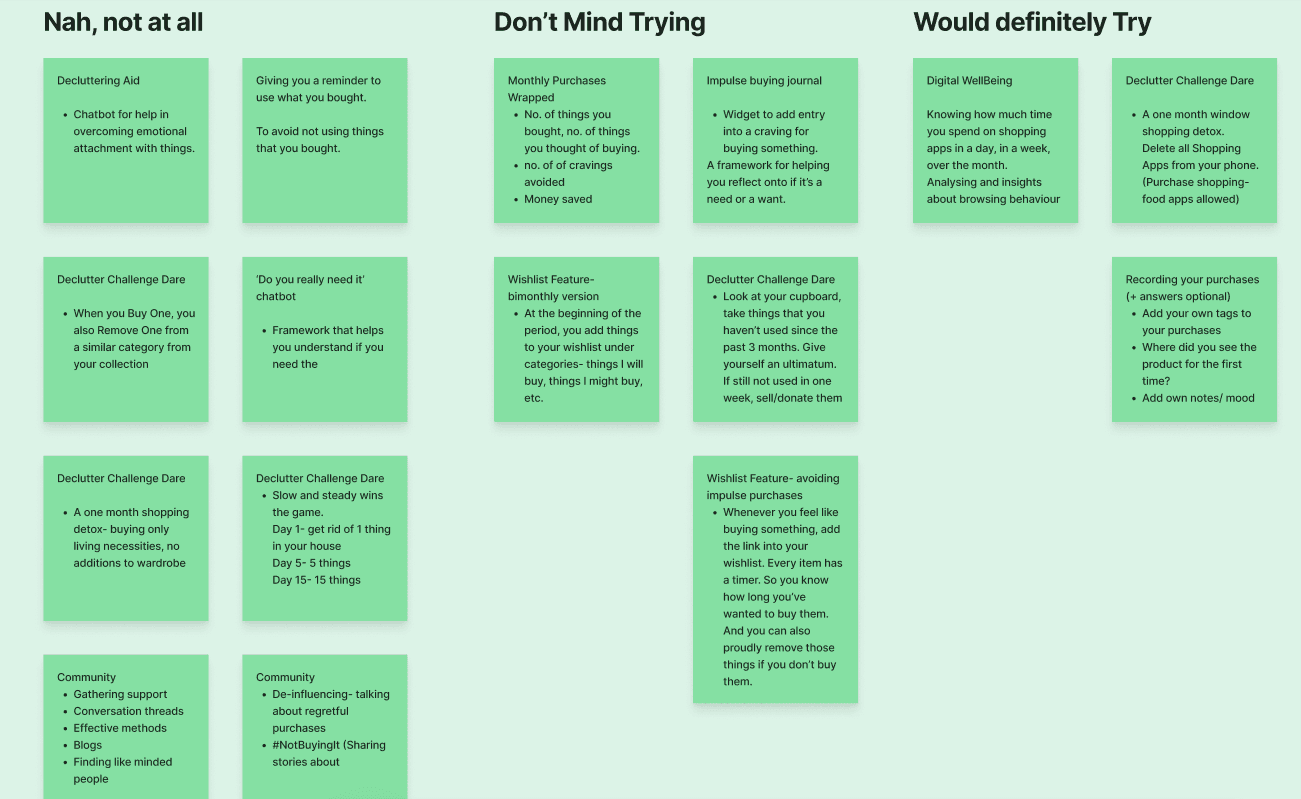
In the last 15 minutes of my Focus Group Discussion, I played a card sorting game with activities inspired by existing techniques to see what would work for my target audience, the Indian consumer.

To my surprise, most options were rejected with comments like ‘I can’t do this’ or ‘That sounds so difficult.’ However, the Wishlist caught some attention, with 2 out of 3 people expressing interest in only trying it.

💡 The People Insight


I realized users rejected most options because they sounded too extreme for someone with no motivation. It was asking for a huge commitment. This made me understand that the key is to make the process approachable.

Phase II of Ground Research

As I set back to research on the insights I had gathered, I came across an interesting campaign on my board before.

💡 The Black Friday Boycott


In 2023, a campaign was launched to discourage consumers from supporting the popular ‘Black Friday’ sales, labelling it as a ‘festival that promotes the purchase of brand new items we likely don’t need.’ This campaign highlights how such sales encourage big brands to produce excessive stock.

Among most of the solutions, including virtual spaces, blogs that encourage and help people improve, this campaign caught a lot of traction and audience.

But why?

Because it was simple. It never said ‘a year of boycott’, it’s just one day of saying ‘NO’ to do your part for the environment and for yourself.

Thus, there was a need to make it approachable and further, provide the necessary resources and guidance to those who are willing to do it.

I tried Decluttering myself

This project began from my personal motivation to stop buying unnecessary things. As my research progressed, I decided to give it a try, but I wanted to develop my own technique.

Books that I read and want to preserve

Books that I haven’t read, but want to

Books that I read but don’t want now

Books that I took from my mom’s shelf but don’t want anymore

Books that I never read nor intend to

Books that I bought just because they were cheap or a bargain

This project began from my personal motivation to stop buying unnecessary things. As my research progressed, I decided to give it a try, but I wanted to develop my own technique.

I was shocked as to how much clutter I had owned. I put them in a box and got store credit (worth Rs. 1,800 😳) as I sold them to a bookstore. And that’s when I realized how removing things from my life would both financially and mentally benefit me. And I wanted to scream and tell everyone about my achievement and progress.

💡 Giving people doable things


Decluttering sounds like a daunting task that requires time and effort. I needed to provide people with simple starting points, like clearing a bookshelf or a jewellery drawer. I need to give them tips, guidance and especially the motivation to do it.

The Google Survey

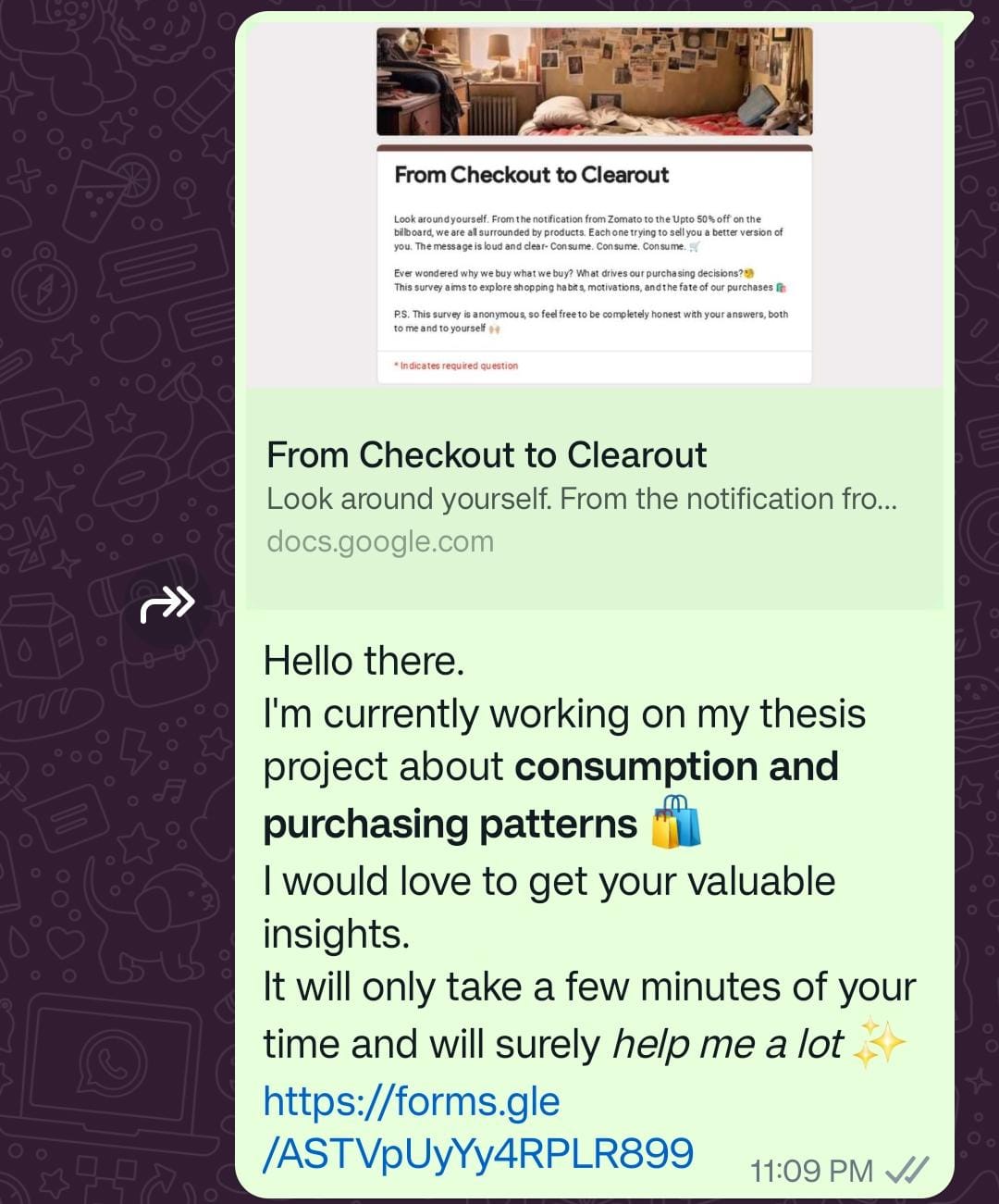
To gain a broader perspective, I shared a Google survey with people from various demographics. This helped validate my claims and gather quantitative data to support my solutions.

91%

People want to be more mindful of purchases

73%

People think that they own too many things.

72%

People would be open to getting guidance to decluttering & trying it.

42%

People don’t declutter for they are emotionally attached to their things.

The survey showed positive results, and hence, I set out to create a solution to hyper consumption using the power of consumer psychology.

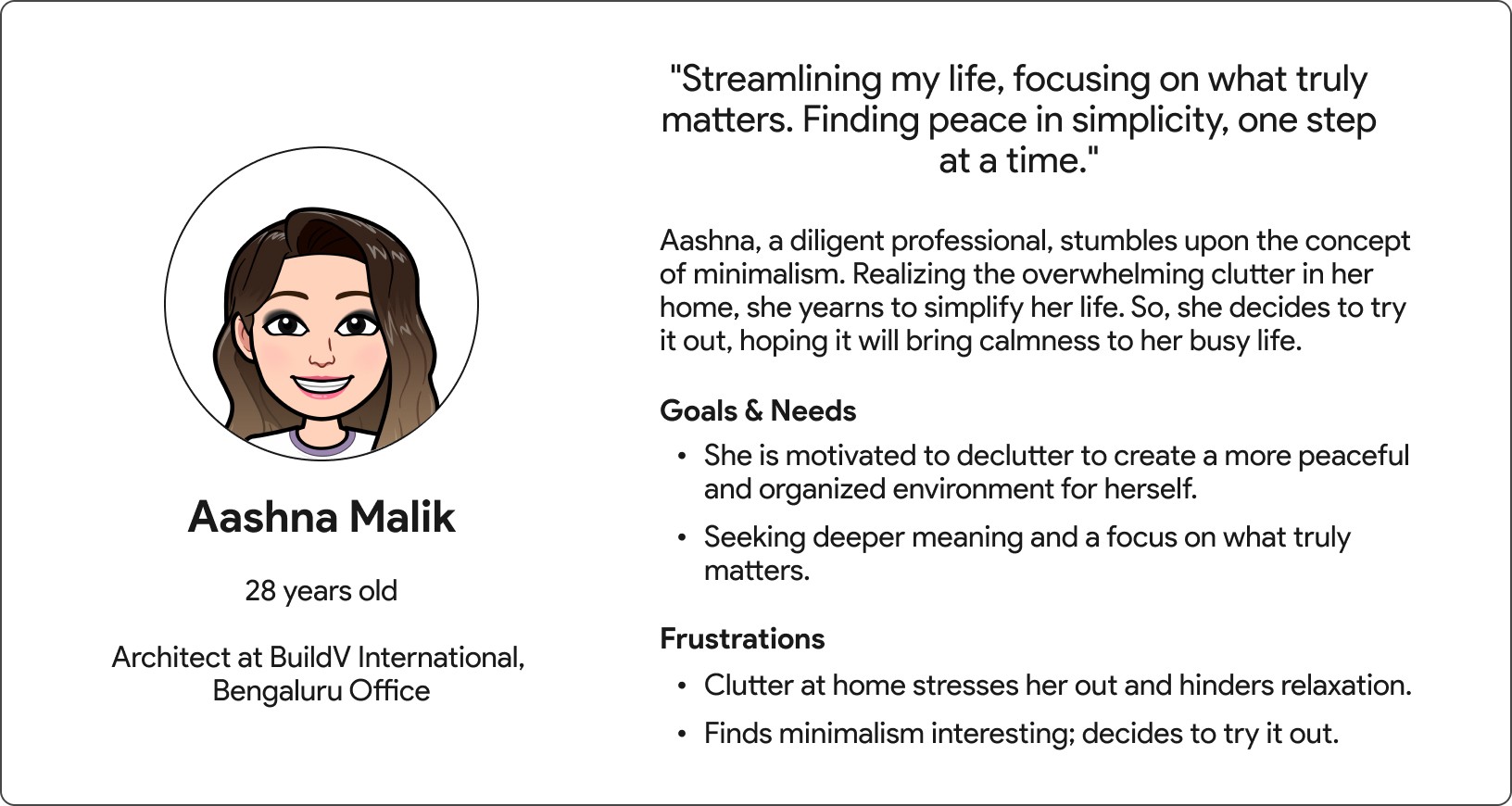
User Personas

 To further explore this, I started looking at existing case studies, journey of people and their stories to understand what drove them to make a change to their lifestyle.

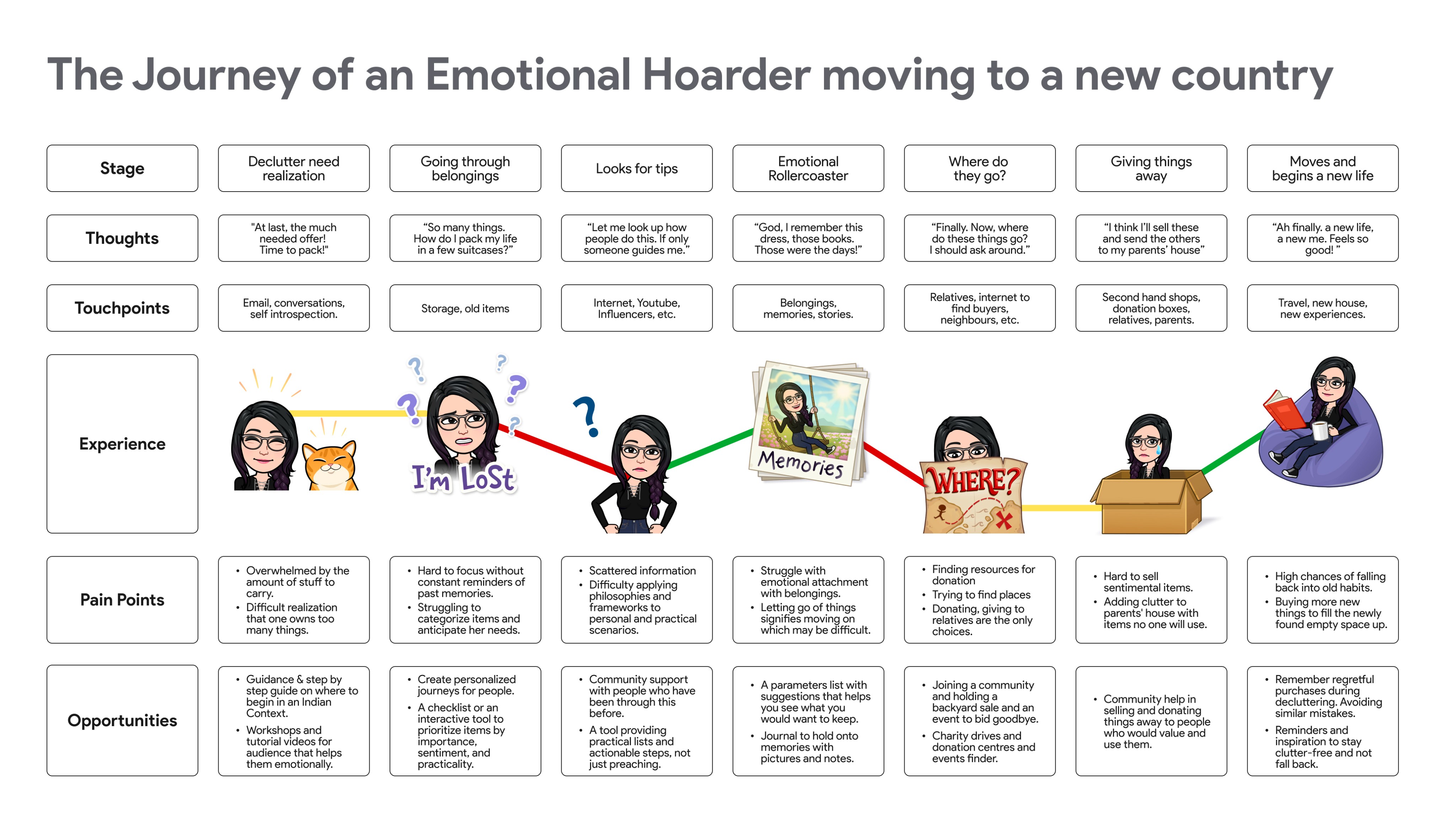
Journey Mapping

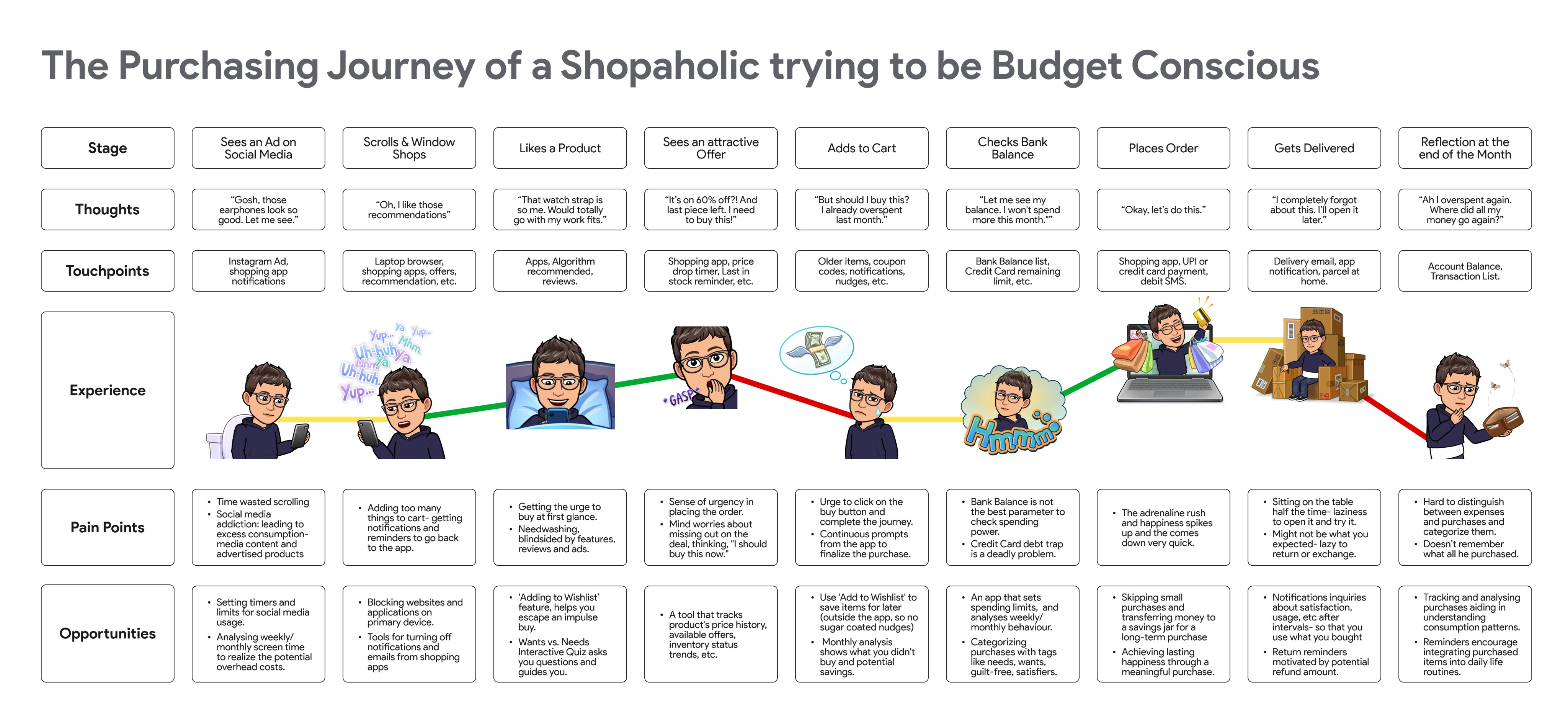
Accordingly, I put together a few user personas and mapped the emotional journeys of potential scenarios to find the possible pain points.

Studying the lifecycle of things

To classify and arrange all the identified problems, I started studying the lifecycle of things from a consumer perspective. I divided them into three stages and classified the problems into various stages.

Buying Things

Impulse Buying

Wants vs. Needs confusion

Budget Control

Buying but not using things

Owning Things

Buying but not using things

Forgetting old things

I will use this someday

Realization of ‘too much’

Decluttering

Emotional Attachment

Seems like a time taking job

Others might not know the value

Not wanting to throw stuff

Possible Solutions

For every pain point identified, I started thinking and mapping out potential solutions. To my surprise, although the problems seemed difficult-to-solve, they had easy solutions. However, integrating them in an approachable way was needed. All the information was quite scattered, leading to users not even trying to bring the necessary change.

Analysing the Pain Points and Solutions

I analysed existing solutions to these problems. Even though they were all available somewhere on the web, there was a lot of digging involved. Hence, there was a need to bring all these together.

💡 Making the journey easy


It is important to understand that retaining the user was a difficult task. To make sure that the drop rate is minimal, I needed to make the journey engaging, motivational and consistent.

When you buy one, you also remove one at the same time

De-Influencing- talking about regretful purchases

Community support, guidance and companionship

Wishlist Feature- add products and revisit later

Impulse Buying Journals

Declutter Dare- Day 1, get rid of 1, Day 10, get rid of 10

Wishlist Feature- bimonthly/ weekly feature

Purchases Wrapped- analysis and insights about behaviour

Things you haven’t used- give yourself an ultimatum

Recording your purchases

In a nutshell, I further needed to solve...

😩 Lack of motivation and incentive to continue

🤔 What do I do with the things I want to clear?

⏱️ Feel like a time-taking complex task

📔 Difficulty getting tailored guidance

🇮🇳 Lack of Indian resources available

🖋️ Difficulty in tracking and analysing

👁️ Results are hard to visibly notice

📱 No awareness about existing tools

Solutioning and Prototyping

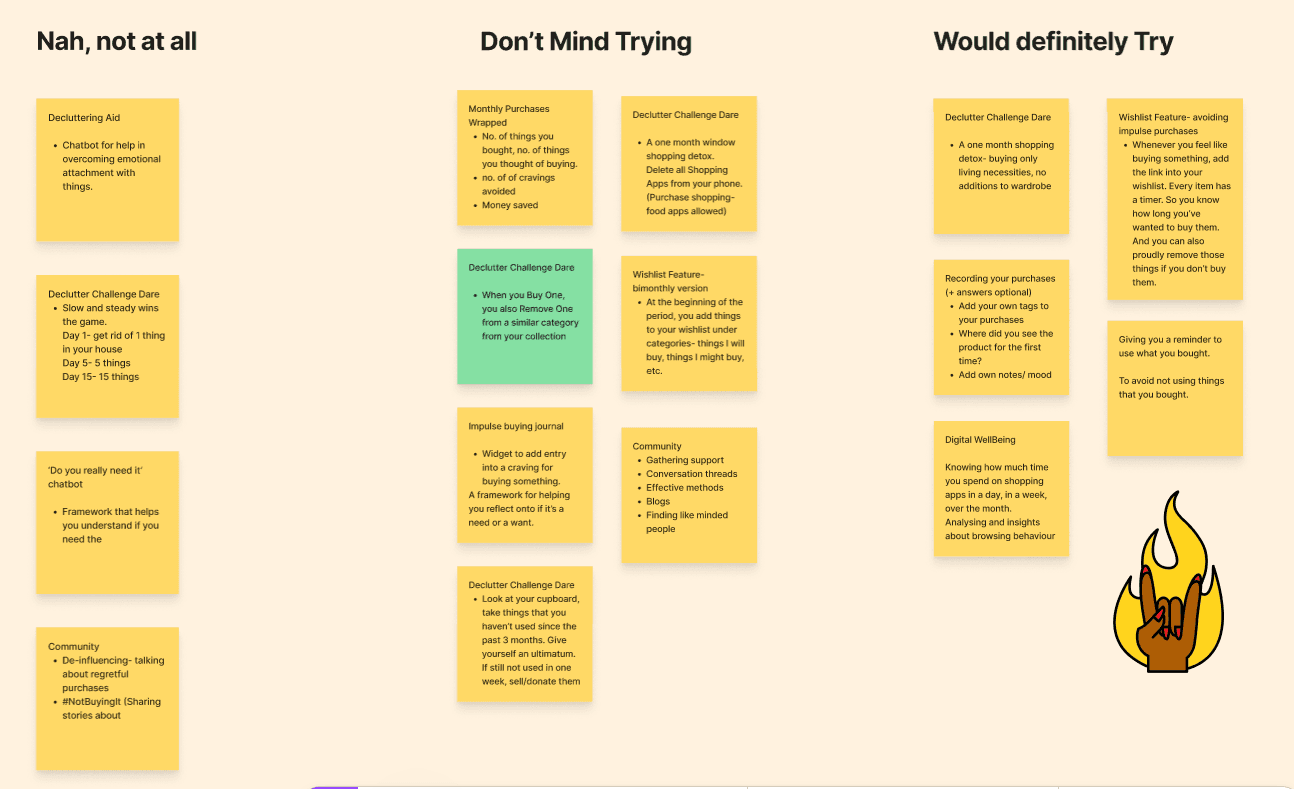
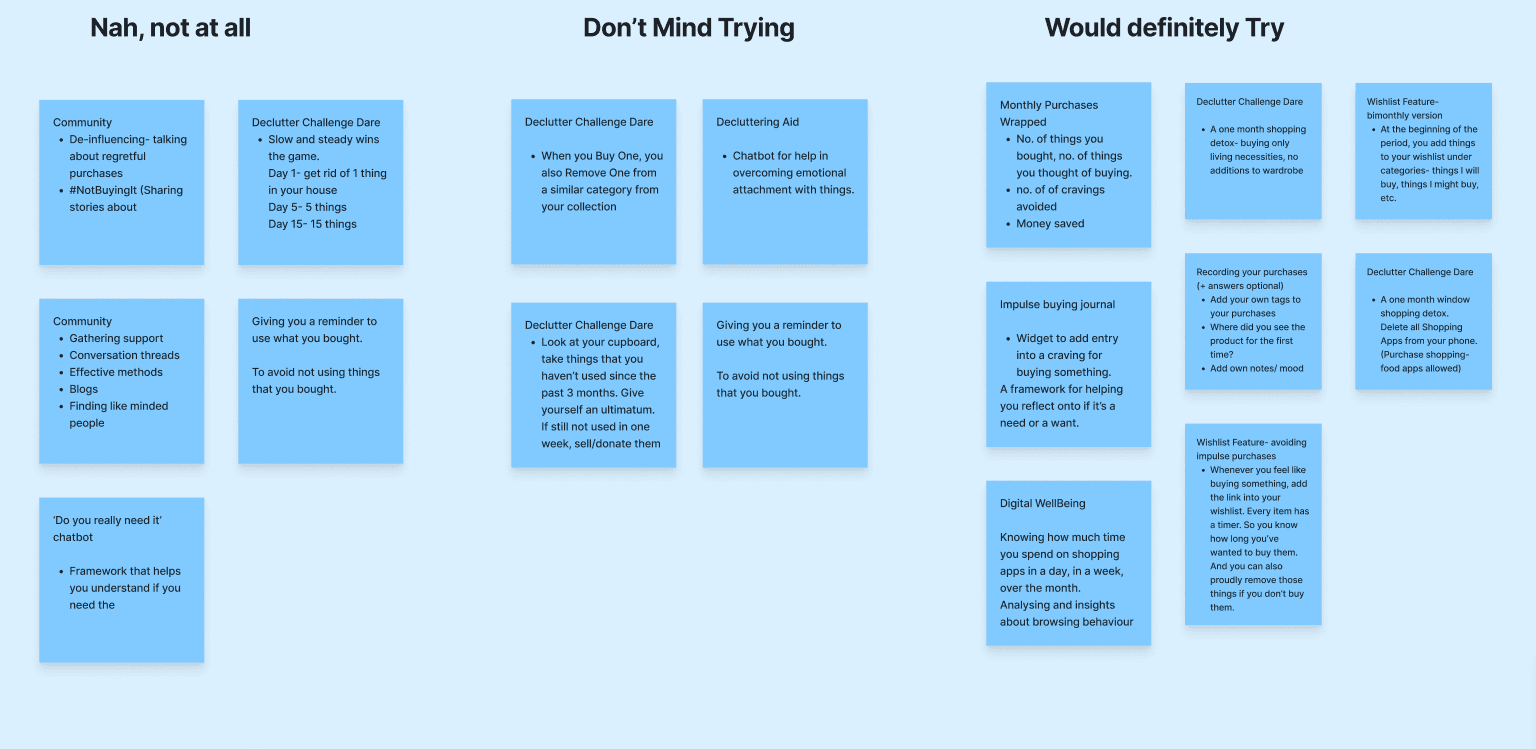
From all the solutions I gathered, I created a laundry list of ideas, activities and tasks that people could try. The key being, none of them were extreme or required too much commitment. I asked 7-8 people to card sort these ideas into three categories. 

And then finally...

This time, my prototyping and assumptions were right and validated. There were things people would try- even for fun. Hence, I started working on how I could create a behavioural change through my intervention.

Building a community ;

the perfect solution

At this stage, I also did realise that there are multiple things I wanted to accomplish - 


Awareness & education

Need for self introspection

Ease of use

Bringing about change

Constant Nudges


‘The best place to meet like-minded people is the Internet.’


I realised that the accountability problem could be solved if I could just connect all these people together.


The final outcome would be an application that serves as a tool to aid this awareness and behaviour change + a community for consistency and building a lifestyle.


Conceptualizing the Application

Taking inspiration from habit building applications, I set out to create a prototype for my application. I did a detailed study on how to create positive results in the behavioural change sector. A strong onboarding followed by an easy, fun interface to interact with.

💡 The Element of Fun


Make decluttering and tracking purchases a guilt free, pleasurable and fun experience. Never blame the user, keep encouraging.
So, gamification was necessary.

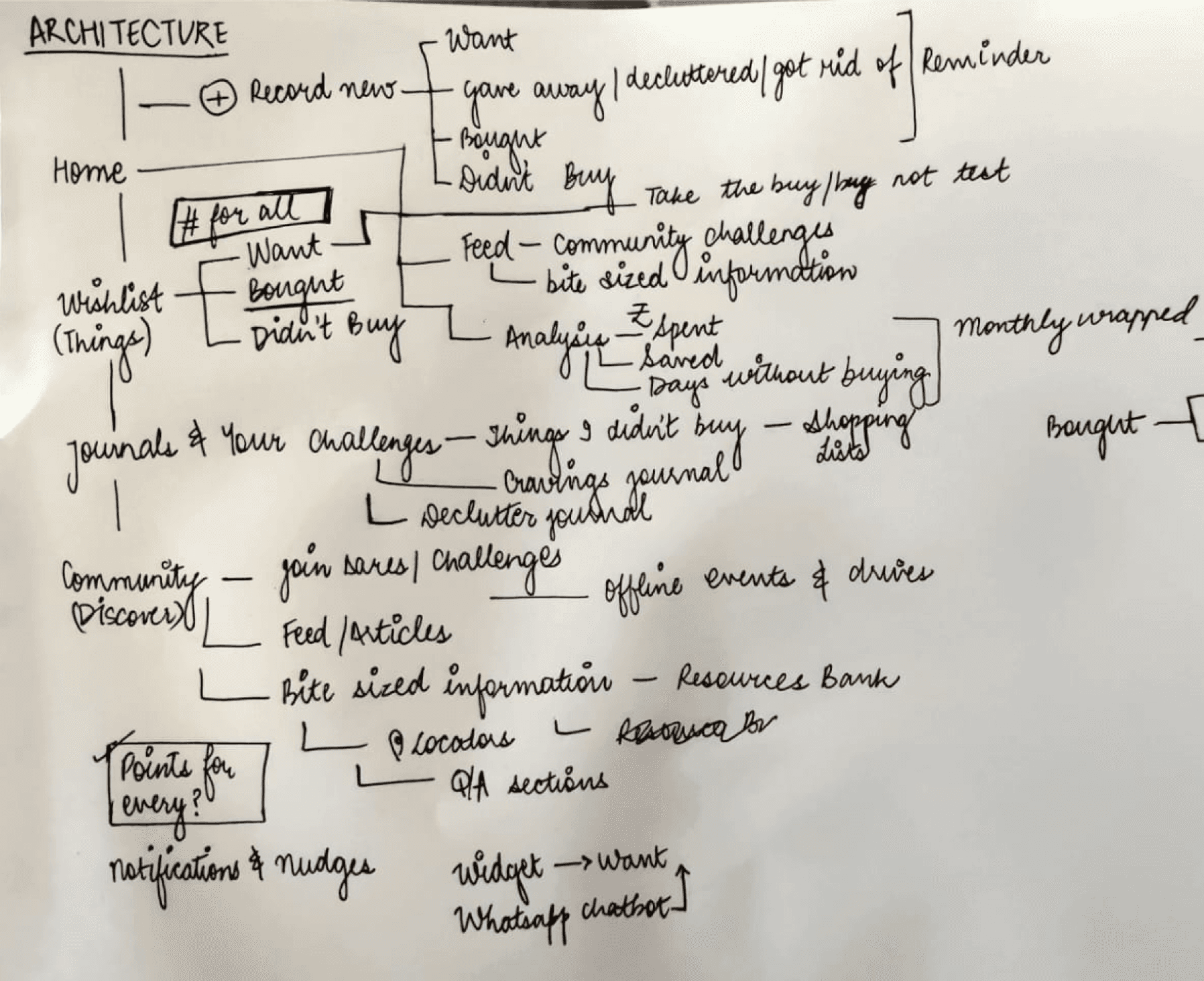
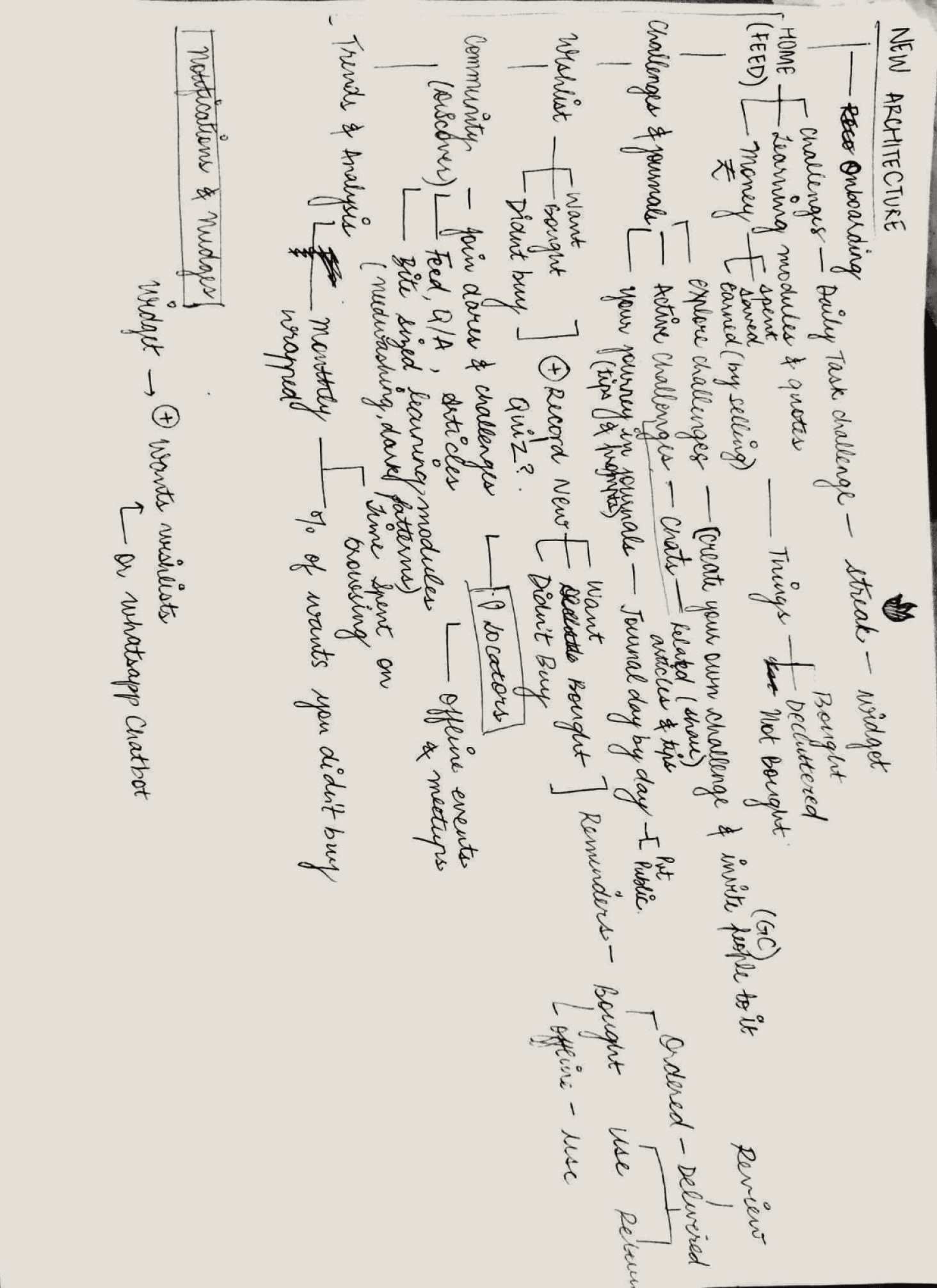
The Final Information Architecture

Post a lot of mind mapping, card sorting and user testing, I finalized my IA and the user flows.

Onboarding

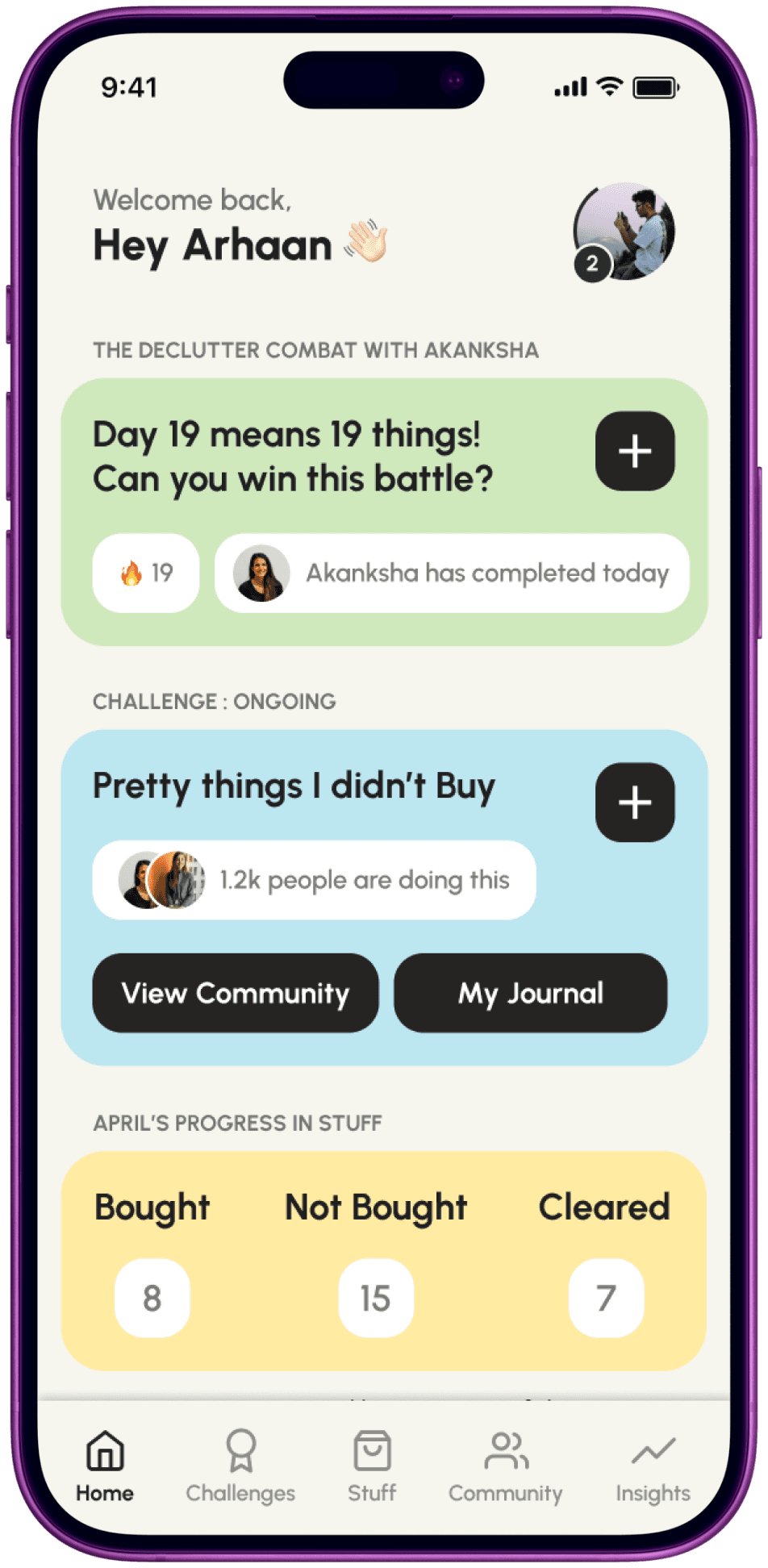
Home (Feed)

Challenges

Stuff

Community

Analysis

Current Challenges

All challenges

Want

Feed

Monthly Purchases Wrapped

Learning Modules

Started

Bought

Chats

Money Saved

Progress

Suggested

Not Bought

Notifications

Resistance Rates

Finished

Cleared

Create a Post

Awards

View Profile

Other Insights

Bought

Not Bought

Decluttered

Community & Feed

Reminders

Popular

Take the Quiz

Following

Your Challenges

Add Journal Entry

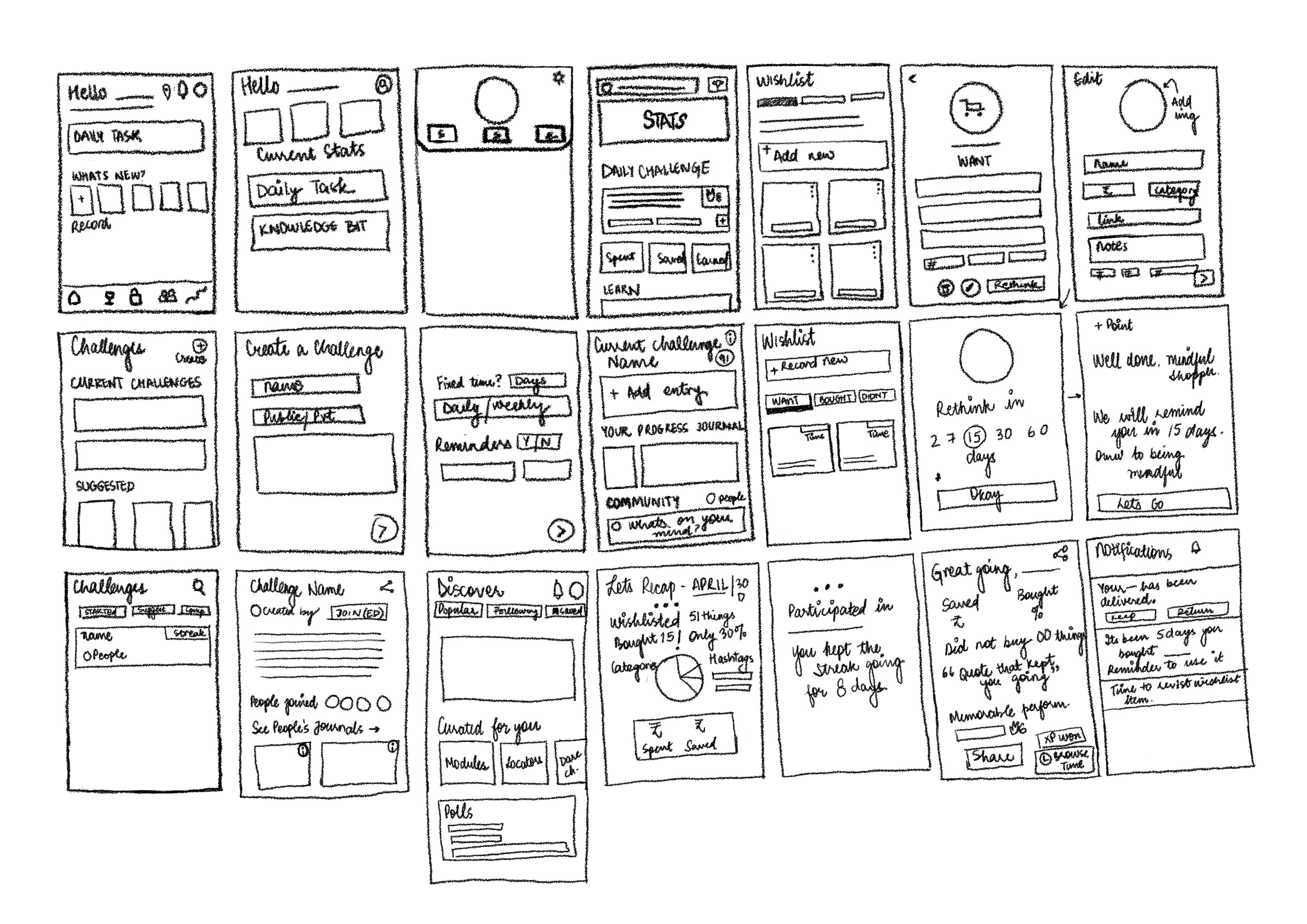
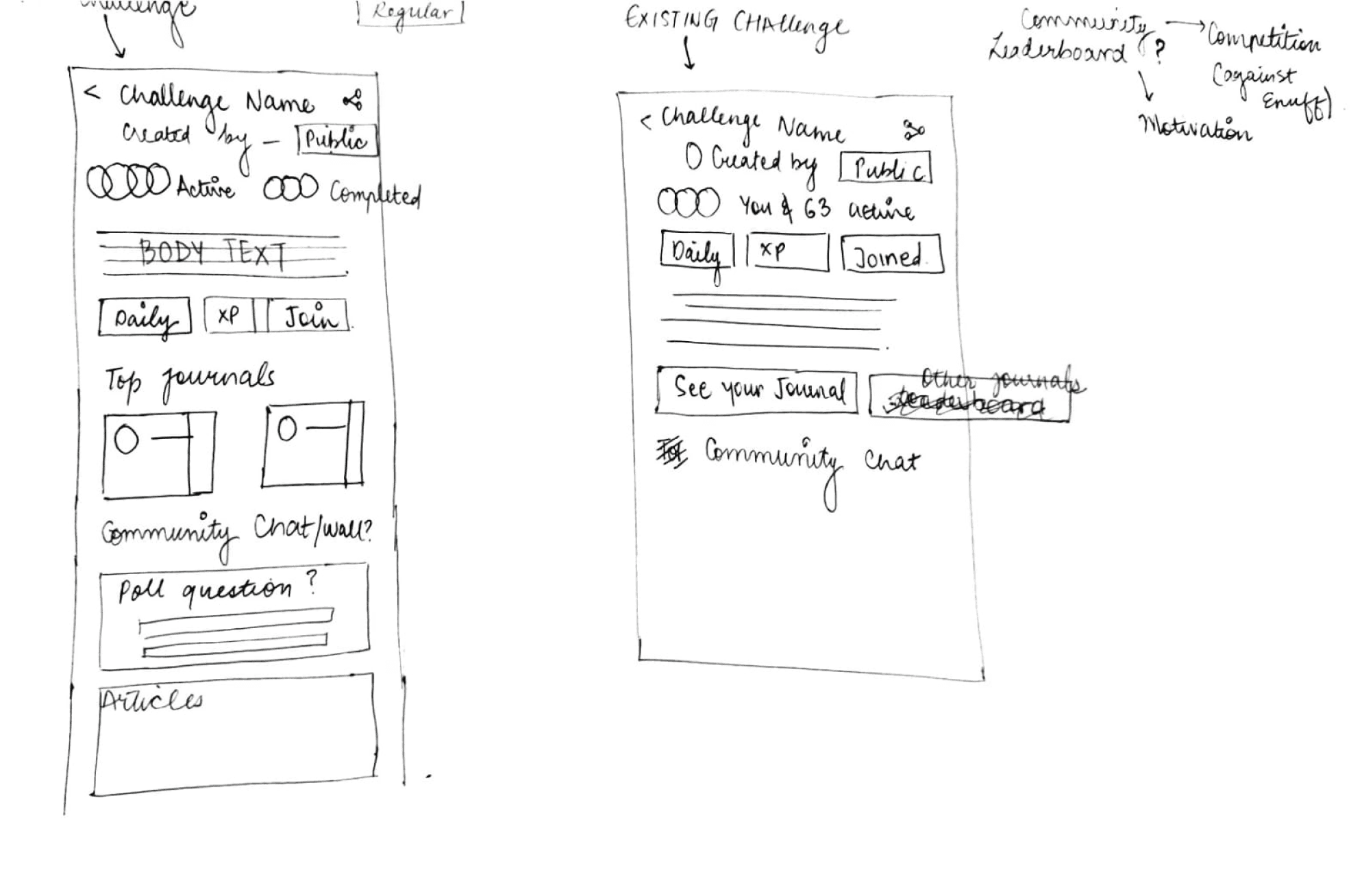
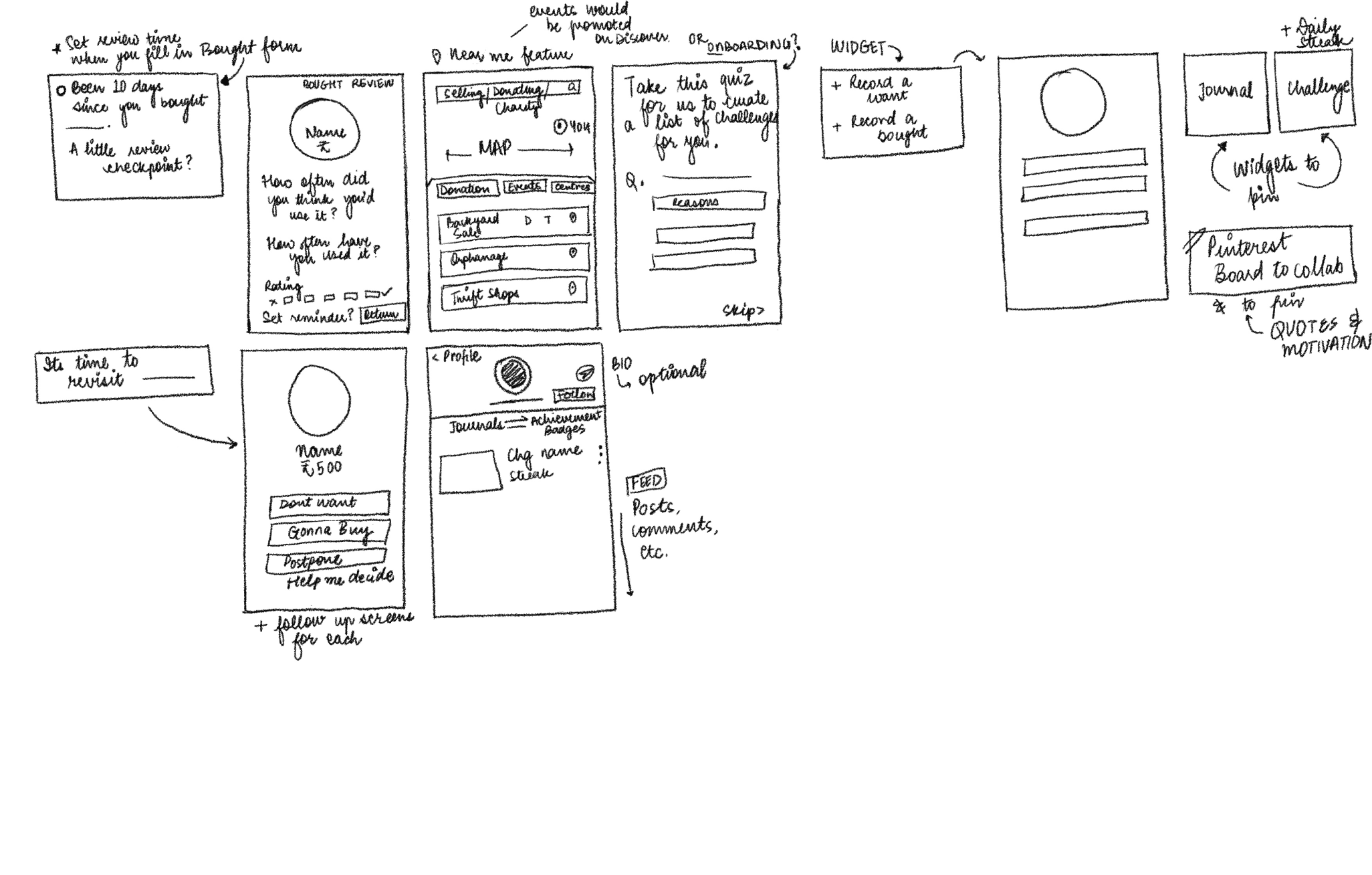
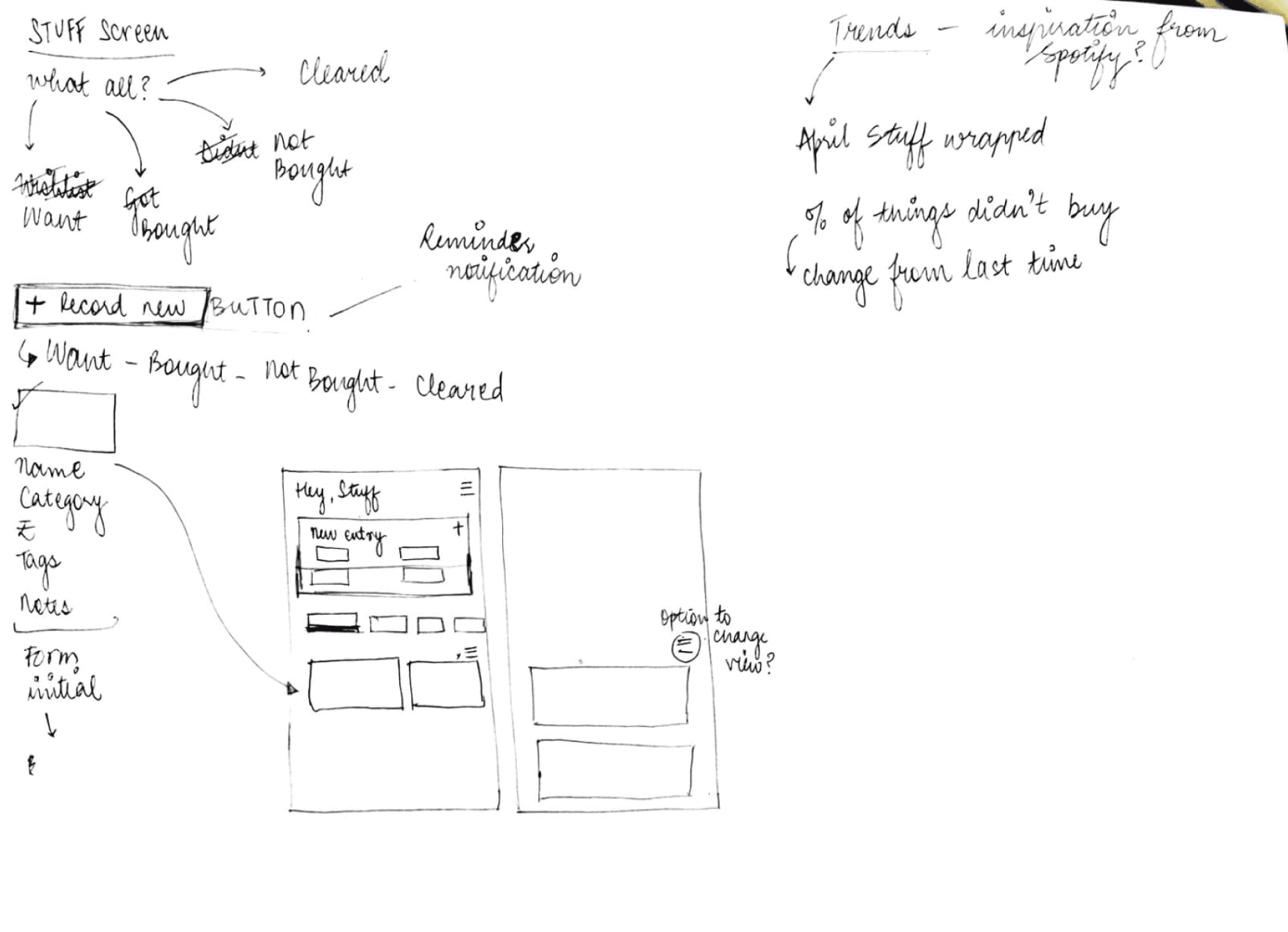
Low-Fi Wireframing

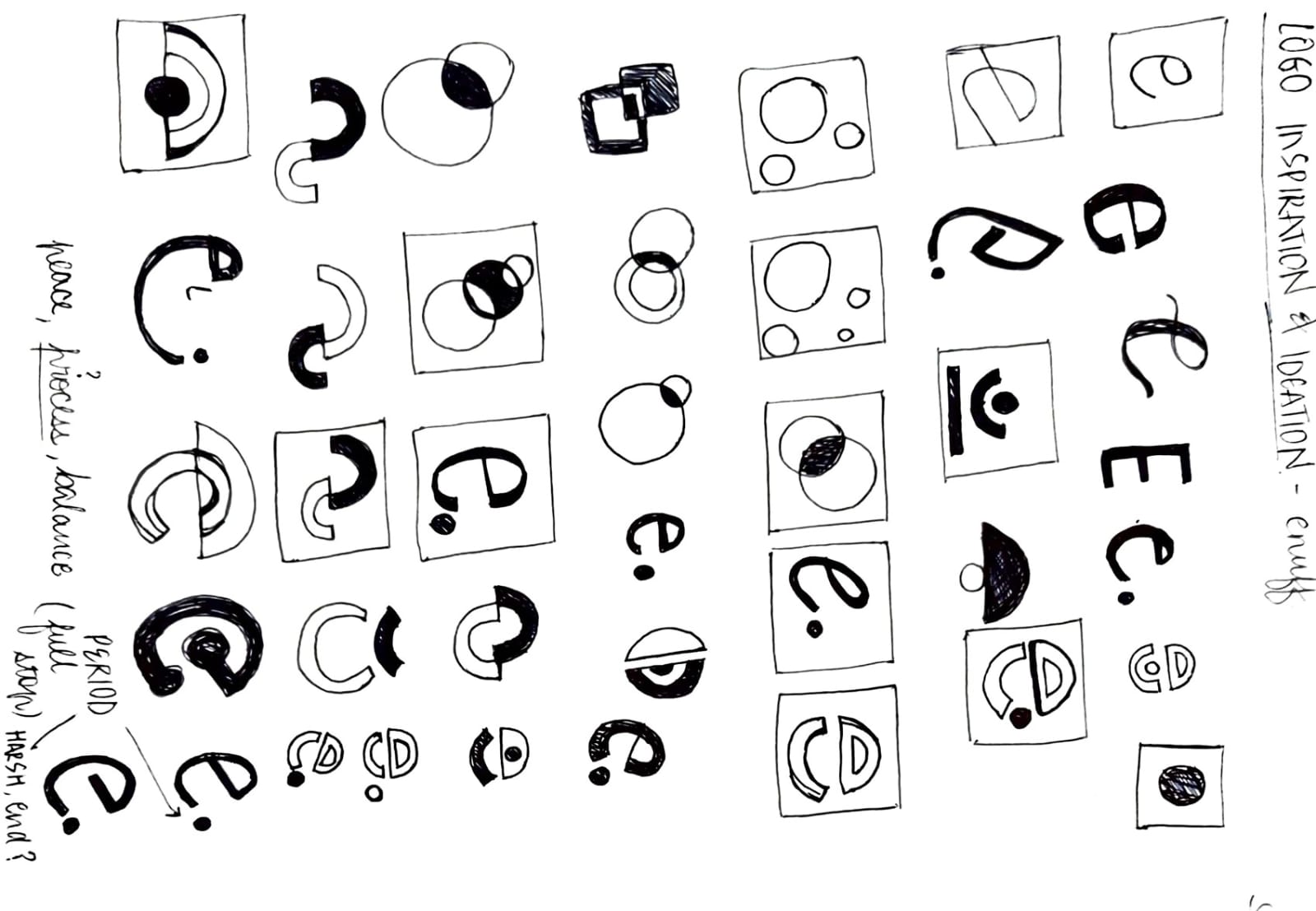
After unpackaging and inventing a newer, more approachable concept, it was time to create a strong brand for this intervention and campaign. I aimed to avoid terms like ‘Minimal,’ ‘Less is more,’ or ‘Conscious.’ Instead, I needed a fresher concept.

Branding and Naamkaran

After unpackaging and inventing a newer, more approachable concept, it was time to create a strong brand for this intervention and campaign. I aimed to avoid terms like ‘Minimal,’ ‘Less is more,’ or ‘Conscious.’ Instead, I needed a fresher concept.

enuff ; The Enough for Your Stuff

❤️ The story behind ‘enuff’


After a lot of brainstorming, research, and conversations, I settled on the brand name which is a playful twist on ‘Enough.’ It’s a fresh concept that doesn’t sound difficult or unapproachable. The idea behind it is that everyone’s ‘enough’ is different, and the app aims to help users find their own balance.

UI System Design

I wanted the design to feel peaceful, playful and welcoming, not strictly minimalistic. So, I avoided the usual colour scheme (60-30-10).


Instead, I chose three soothing colours that evoke comfort and relaxation. Using multiple colours helped avoid an overly clean or classic look. Plus, I opted for emojis in the UI design—they’re familiar and give a modern touch.

Typeface: Urbanist

#252422

#FFFFFF

#D0E9BC

#BCE7F0

#FFEBA1

Interact with the working Prototype :)

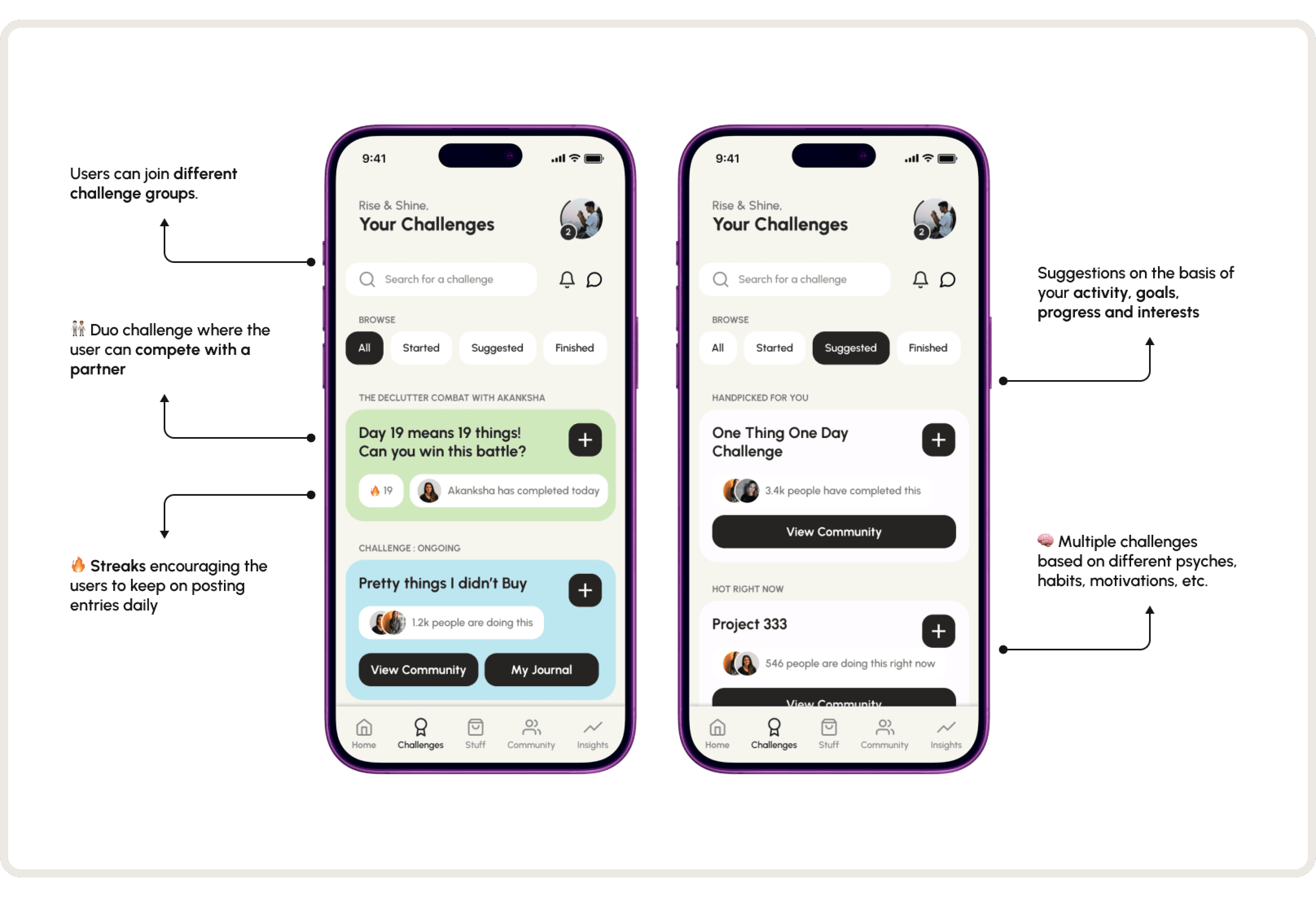
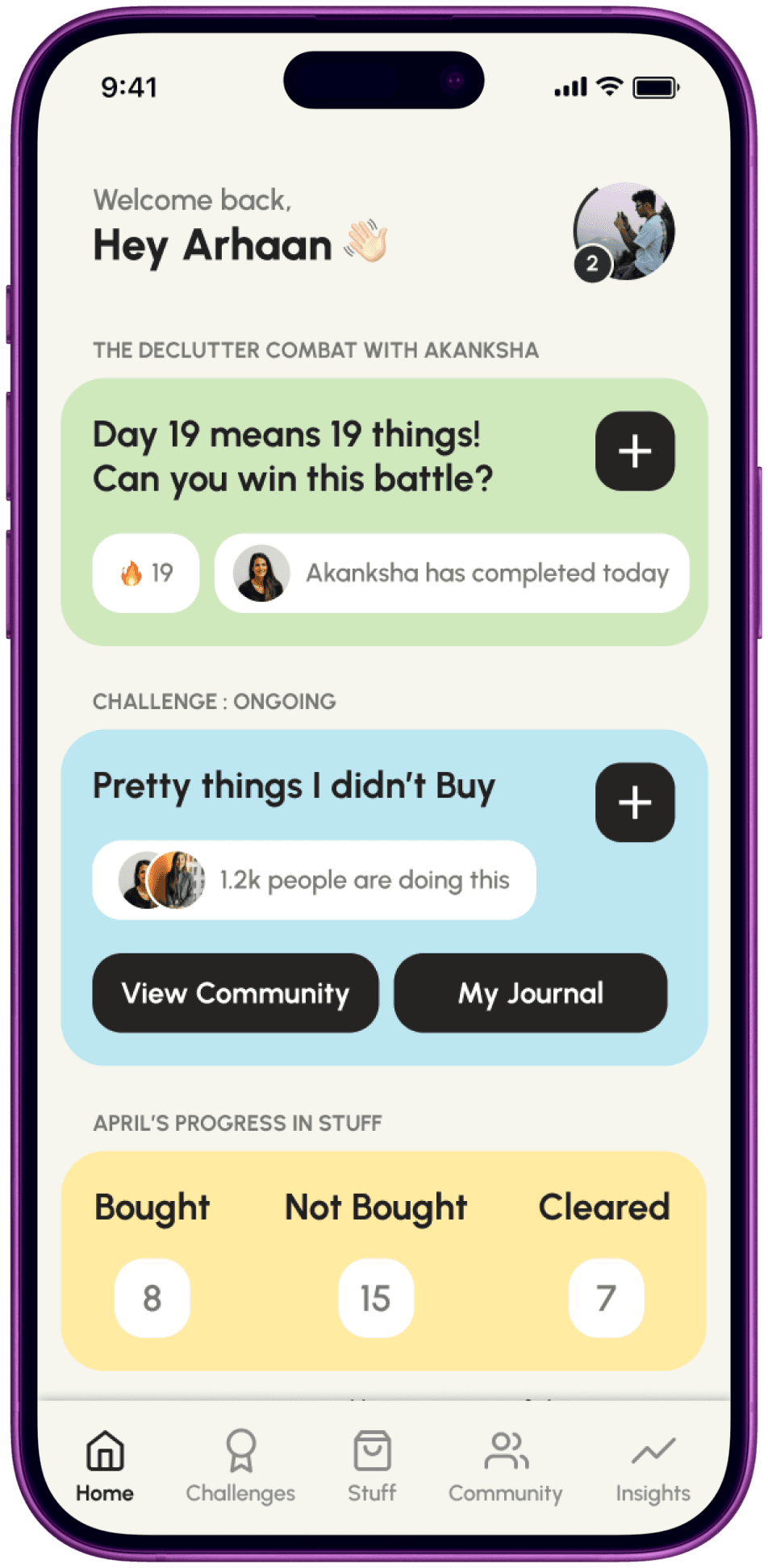
The Challenges Feed

The primary challenge was addressing decluttering. Different strategies and challenges worked for different individuals, depending on their psyches, habits, and motivations.


Therefore, a one-size-fits-all approach wasn’t feasible. But what if I offered them the freedom to choose? By providing various ideas and prompts, they could select, try, and experiment with what suited them best.

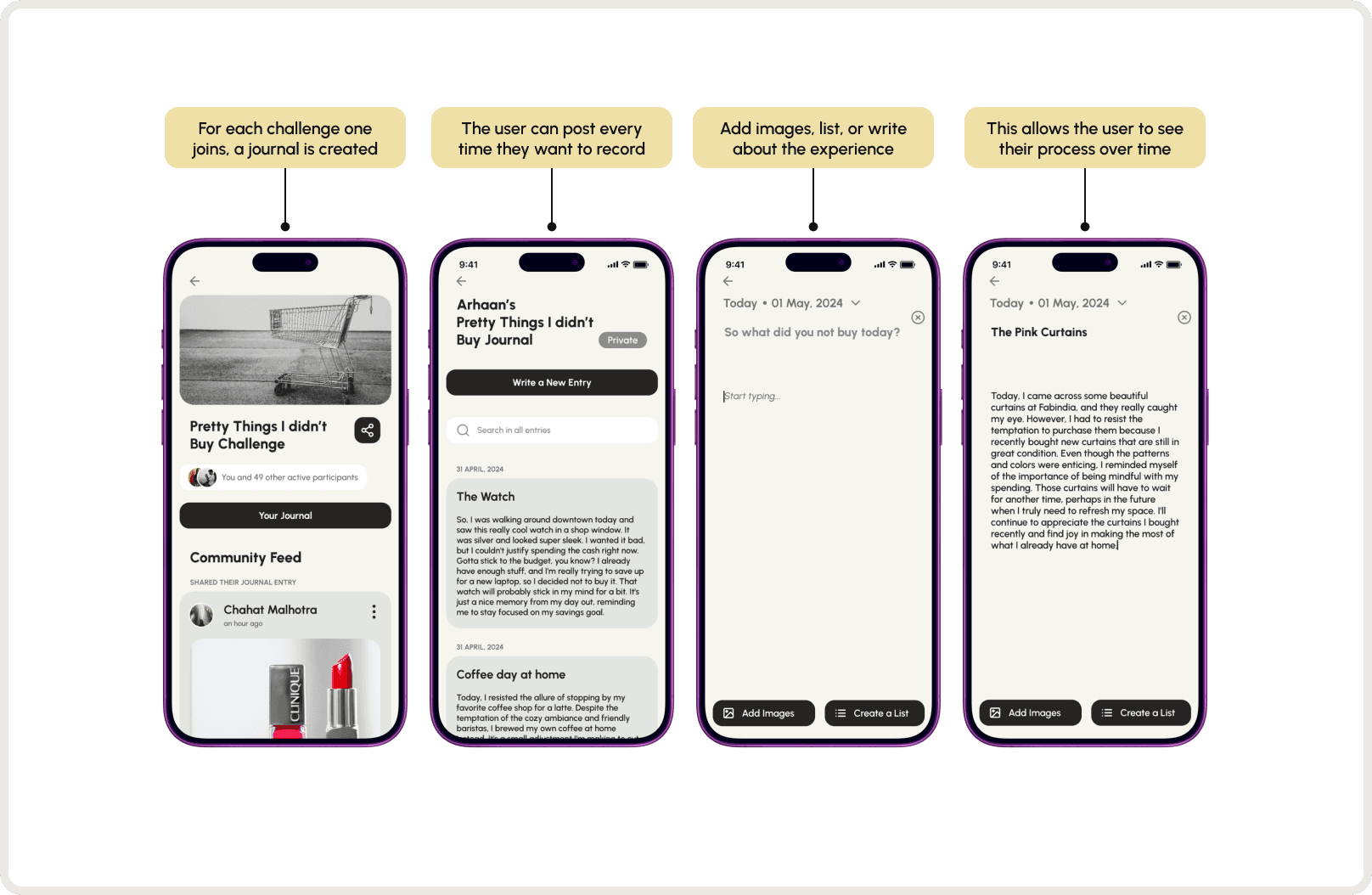
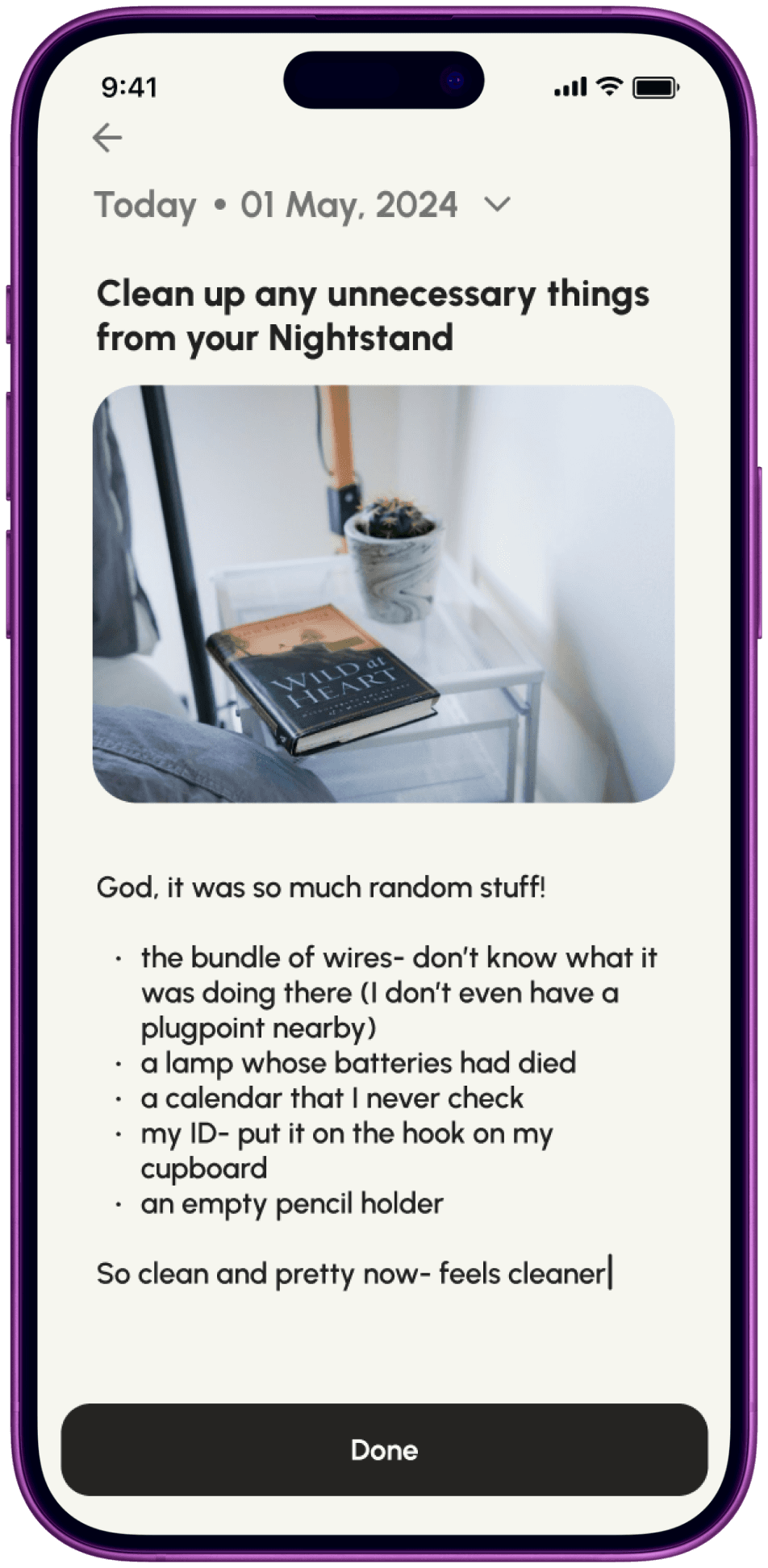
Journals for Challenges

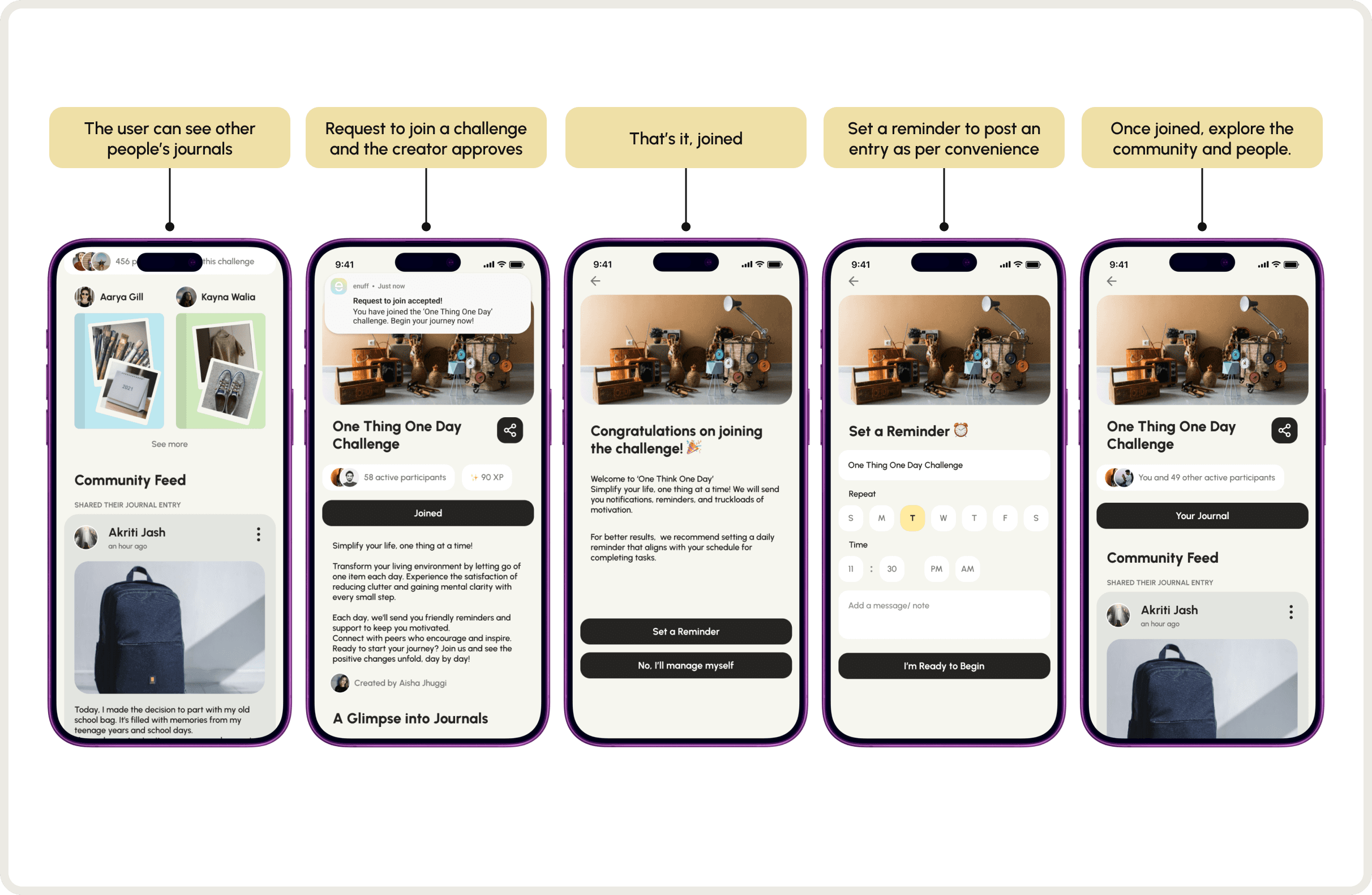
A journal is the key to maintain consistency. Every time a user wants to record them performing a challenge, they can add an entry writing about their experience or just post before/after images. 

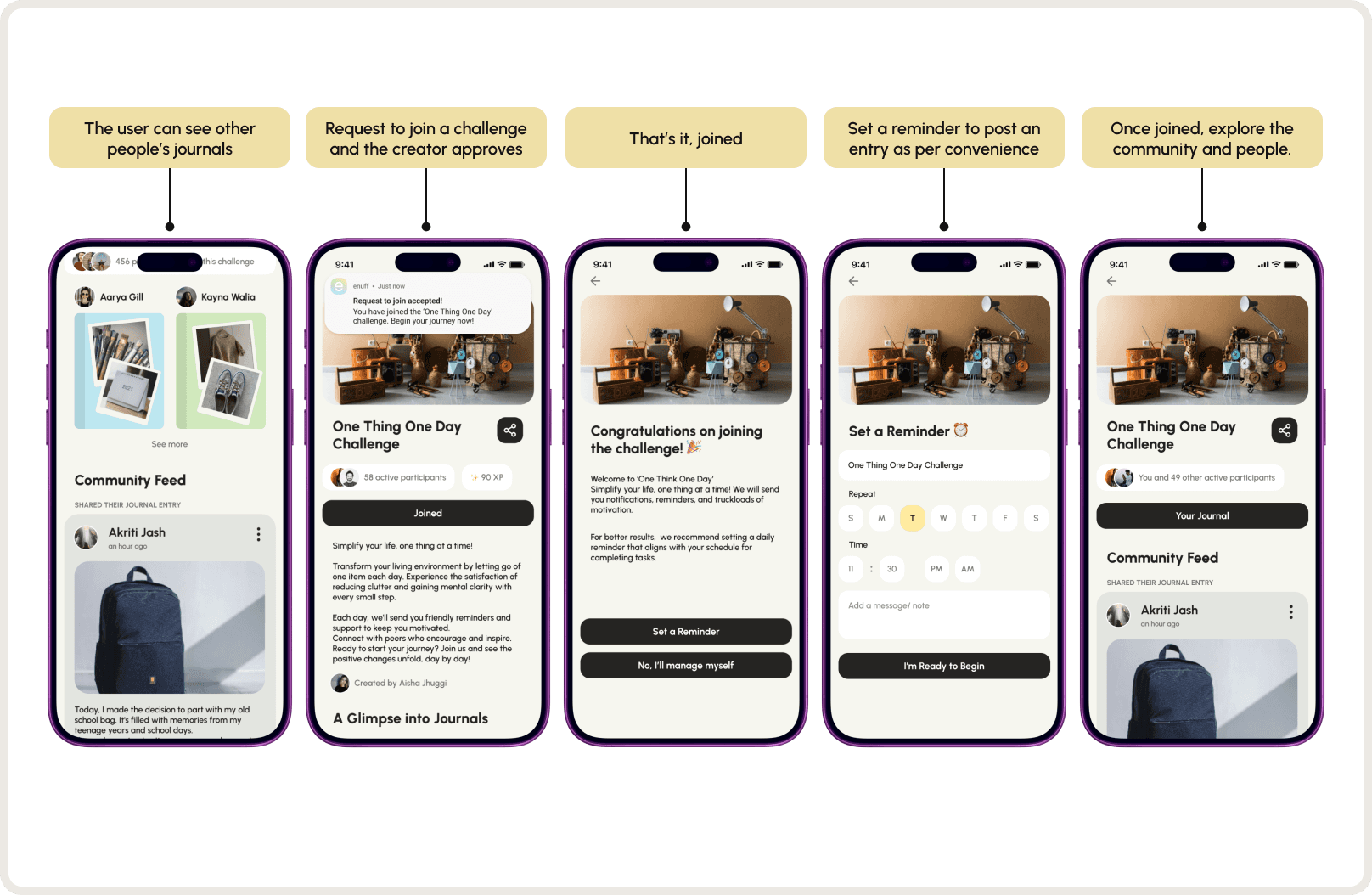
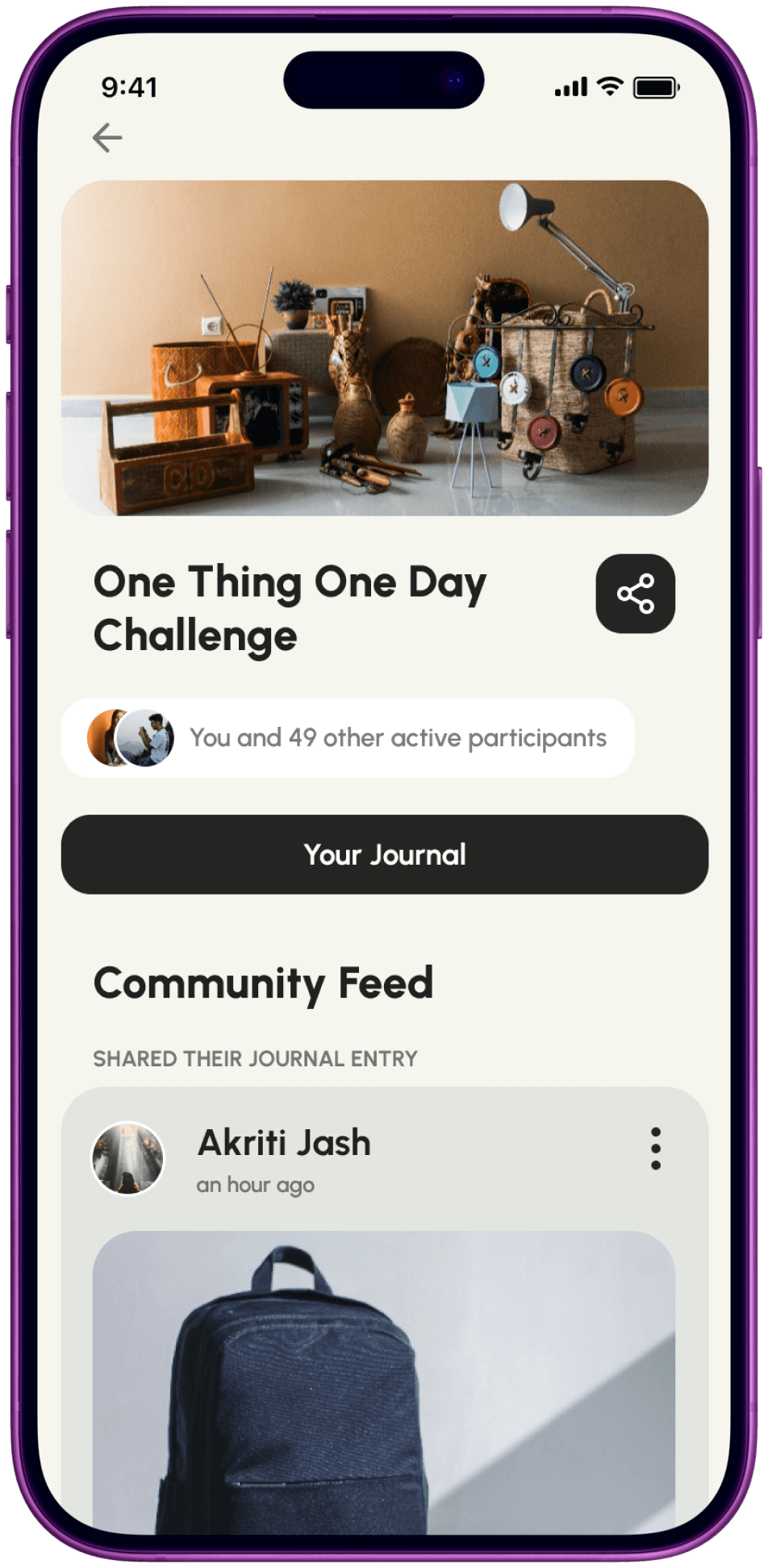
The user can also connect with other people who have chosen to do the same challenges- in the challenge community. This makes the user feel that they aren’t alone in this. The feeling of being in a social community acts as a motivation to continue their journey.


Some communities can be ‘invite-only,’ meaning you have to earn the right to join. You can also create family or office communities to keep the competitive spirit alive with the people you know in real life.

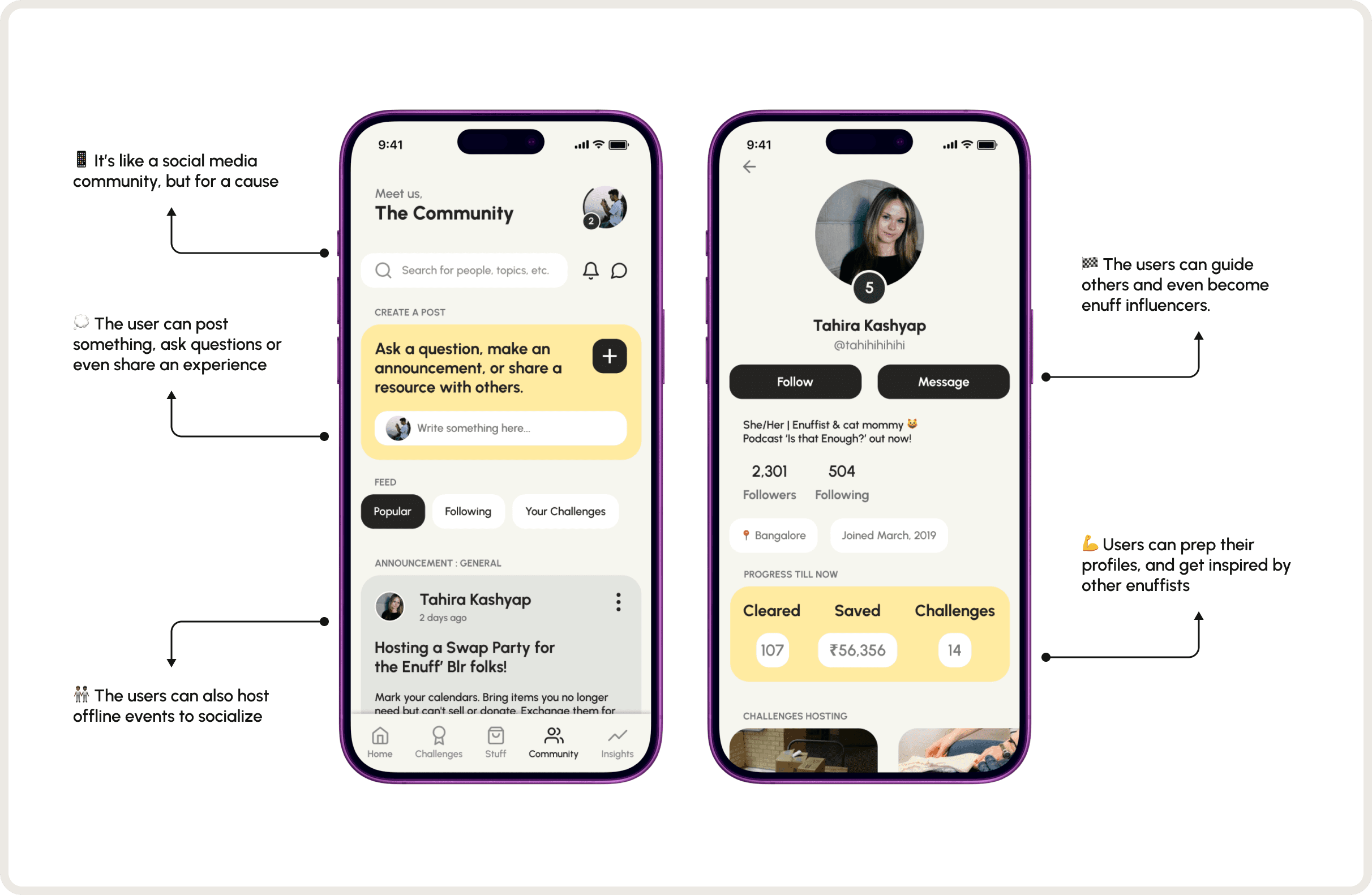
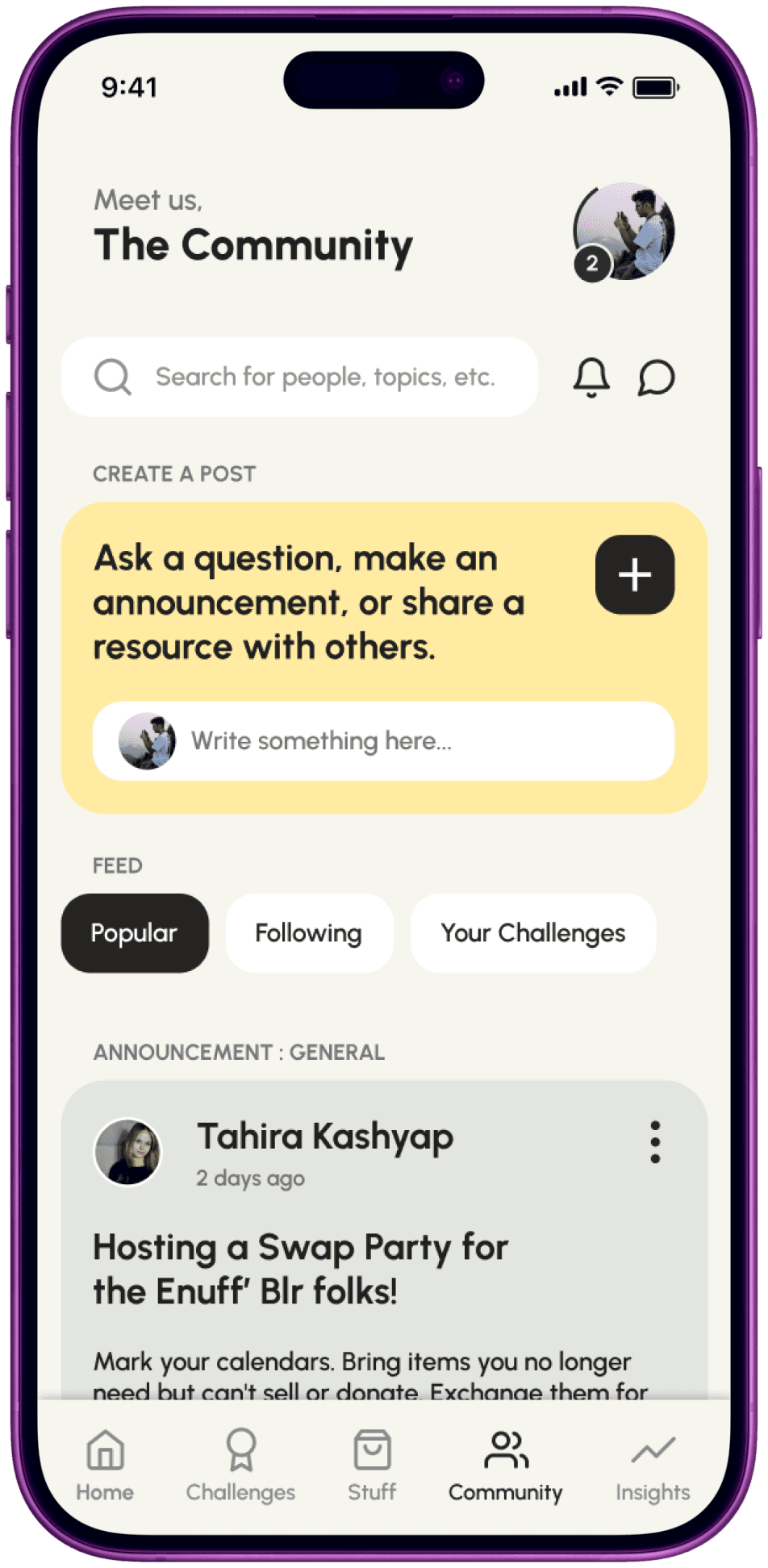
Connecting with the Community

This is a place for all the enuffists to connect, talk and share resources. The users can also share their problems, achievements, etc. with others in the community.

Onboarding Journey

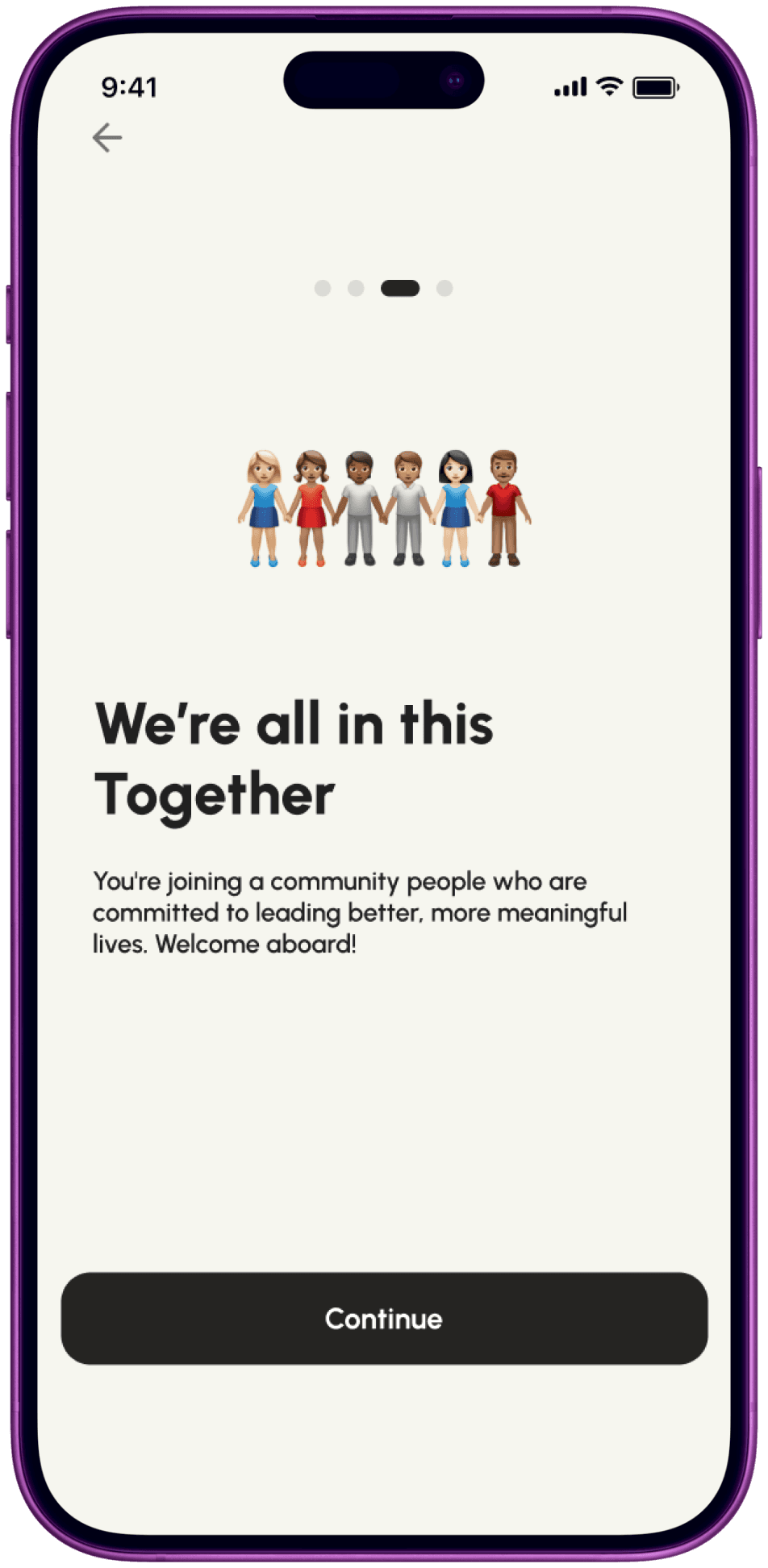
It was crucial to highlight the key features and guide first-time users to experience the fun of being an enuffist. To start their journey, a short challenge was introduced. The onboarding process strikes a healthy balance between education and activity.

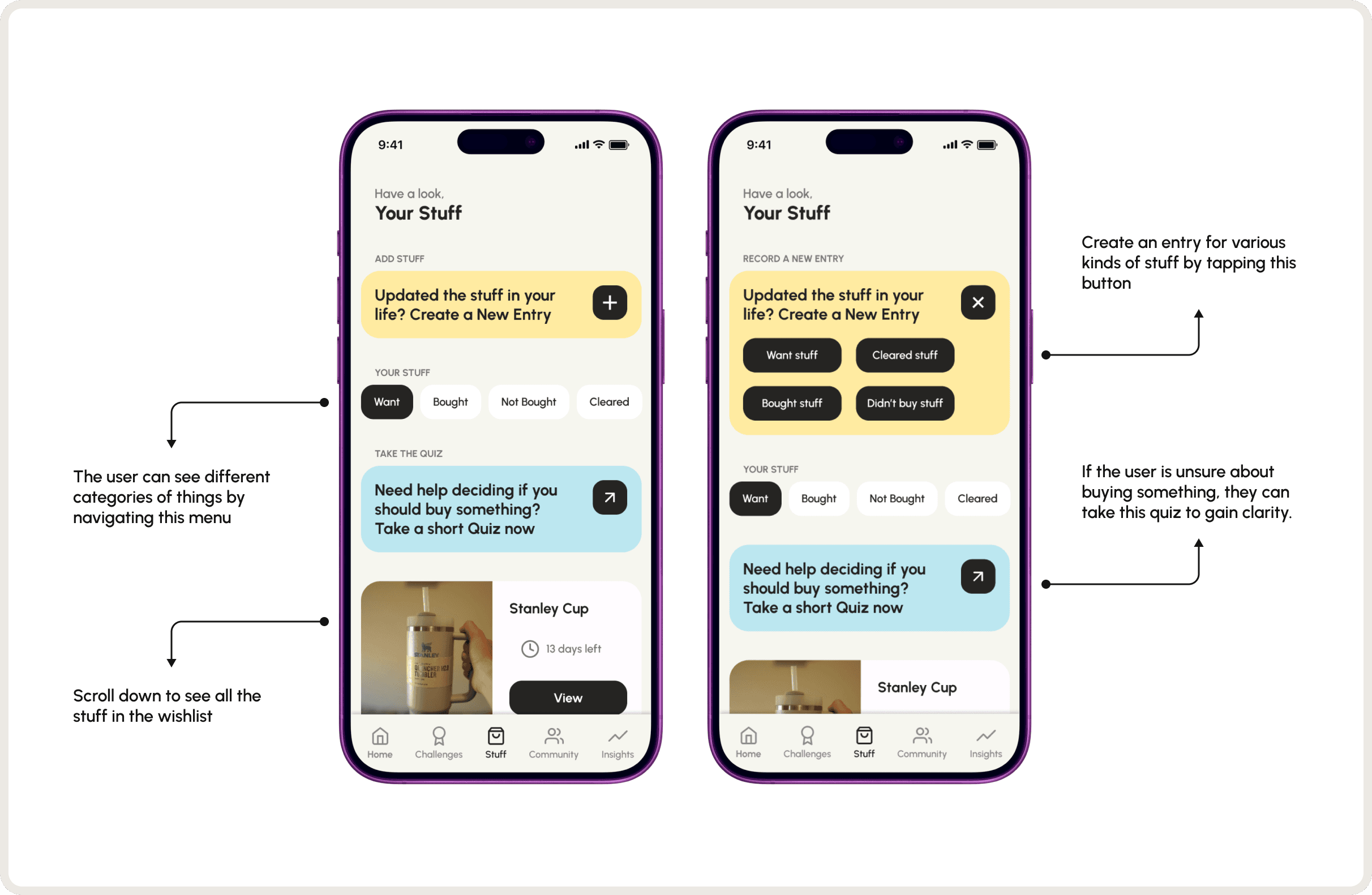
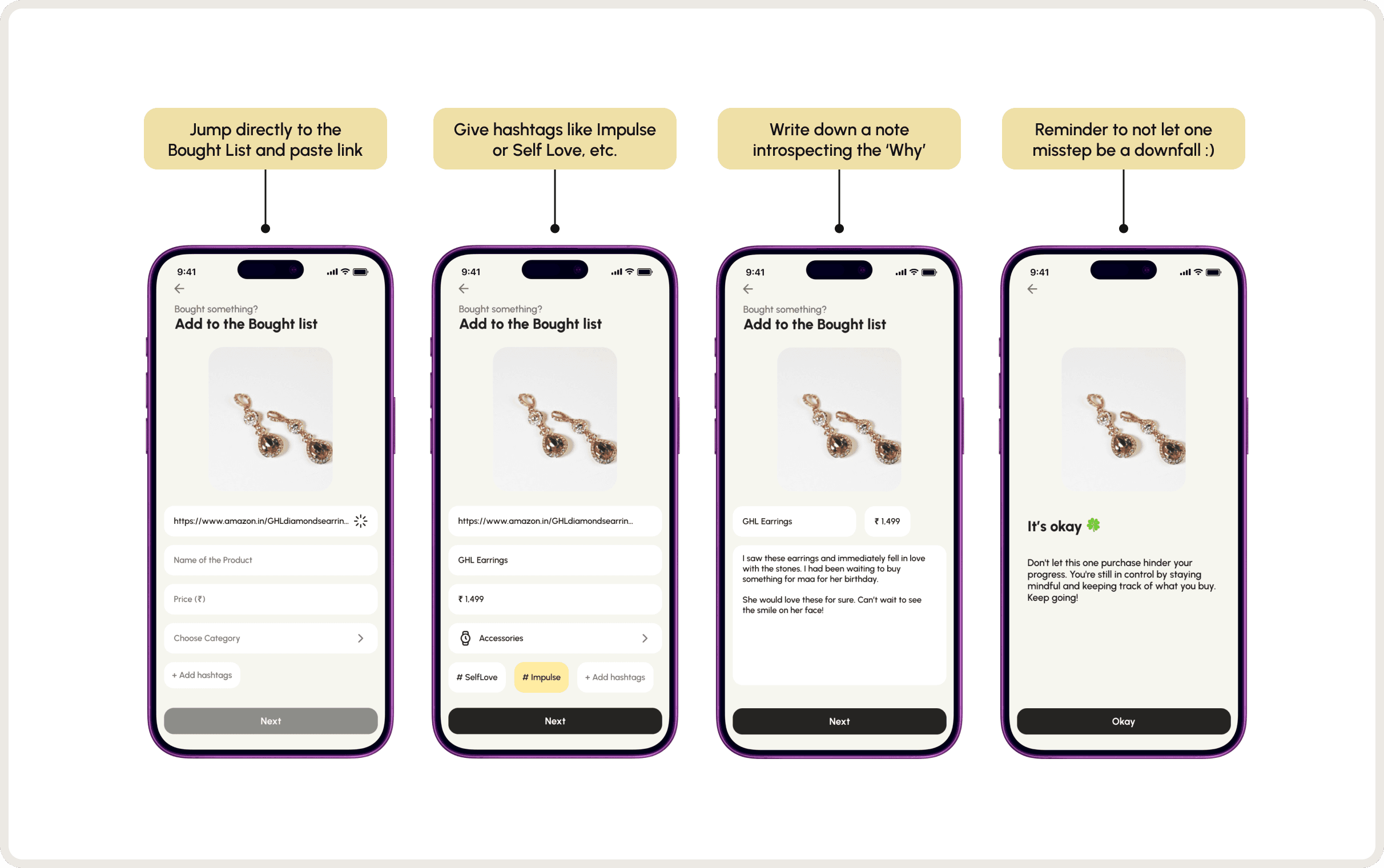
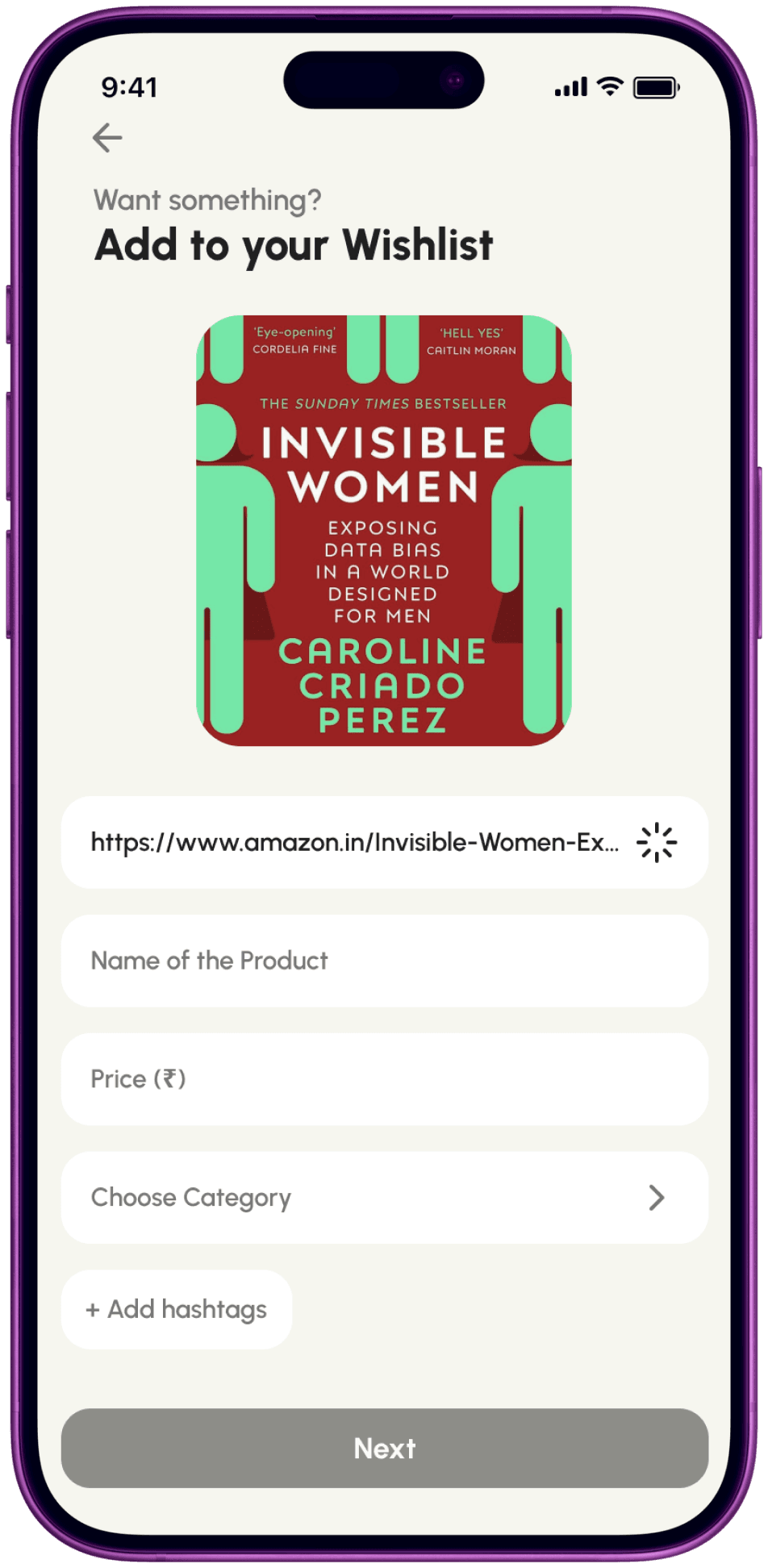
Adding to the Wishlist

It is important to monitor that the user does not fall into the trap of ‘buying new things to fill up the space that is being created by clearing the clutter out.’ This also helps counter the problem of impulse buying.

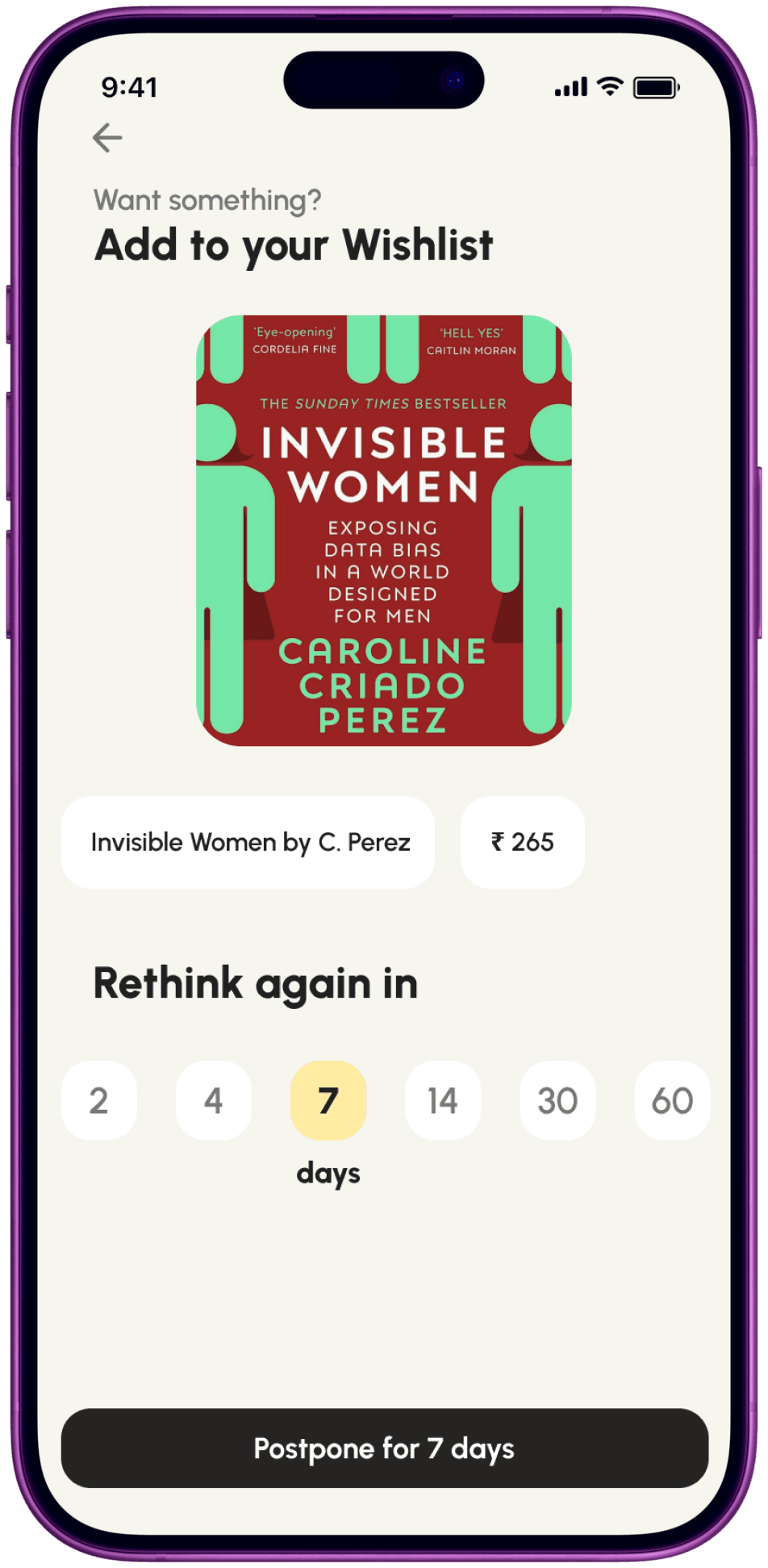
💡 Postponement is the best solution to killing impulse buys


Upon research, I found out that instead of buying a product right away, if you add a product to your Wishlist and come back after a few hours. It’s likelier that you won’t buy it if you don’t really need it. Through multiple prototypes, I decided to tweak the wishlist a bit and innovate with a time postponement feature.

Whenever the user feels like buying something, instead of adding it to the cart (which usually triggers numerous push notifications and tempting price drops), they simply post the link to their wishlist.

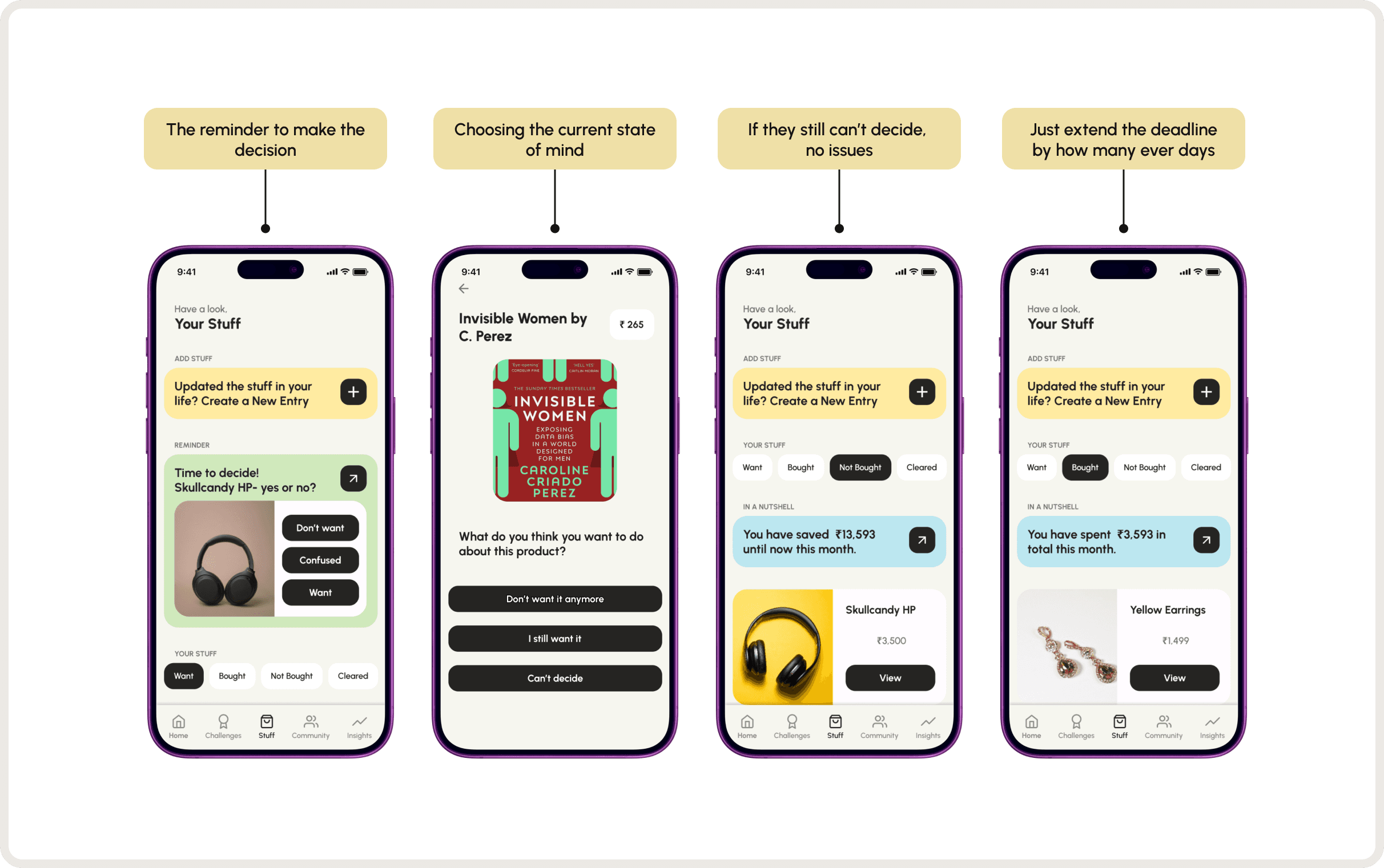
The Time to Decide

When the time to decide arrives, the user can choose among three options.

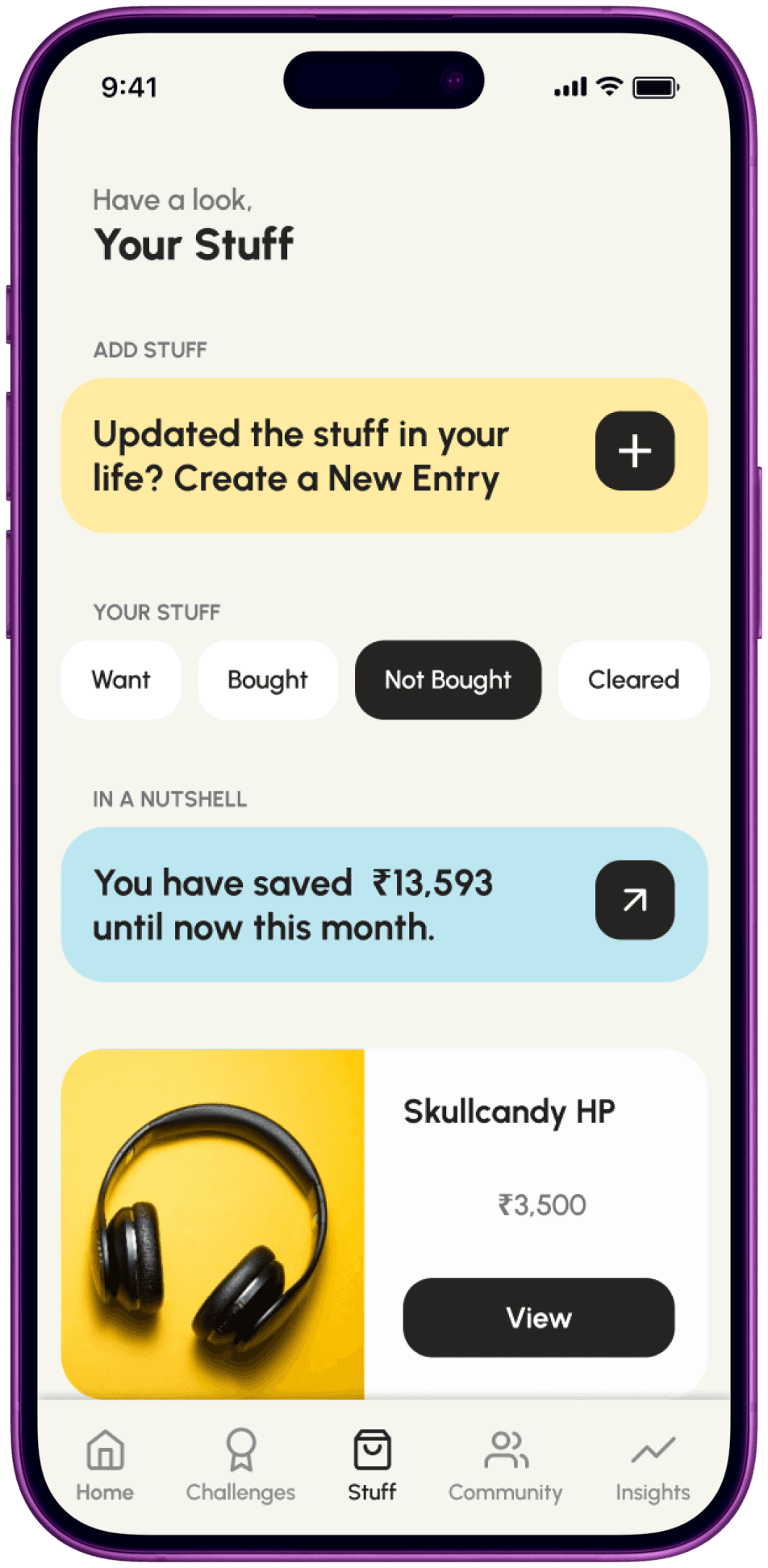
If they choose to buy it, it will be sent into the ‘Bought List’

If they choose not to buy it, it will put the product into their ‘Not Bought’ list.

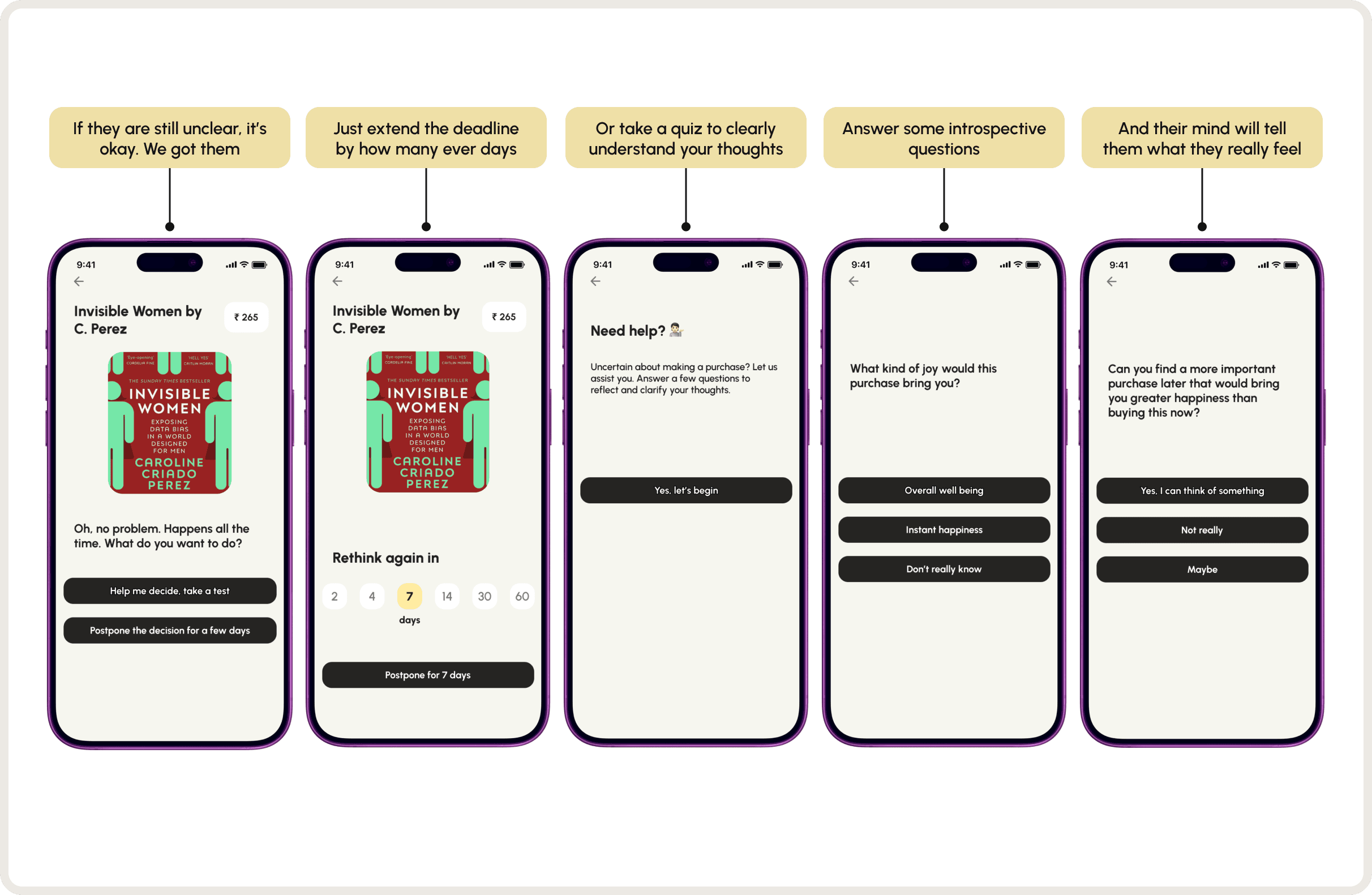
If they are still confused, there is an option to take a short ‘Want or Need’ quiz that will ask them the right questions and help them make a conscious and informed decision. Or they can just shift the decision time to sometime later.

💡 Recording an Impulse Buy


We cannot expect change overnight. It’s okay to slack once in a while. If the user had to buy something in an emergency, they can add the entry into their Bought list directly. No blame or shame. Happens to everyone. It’s a gradual process.

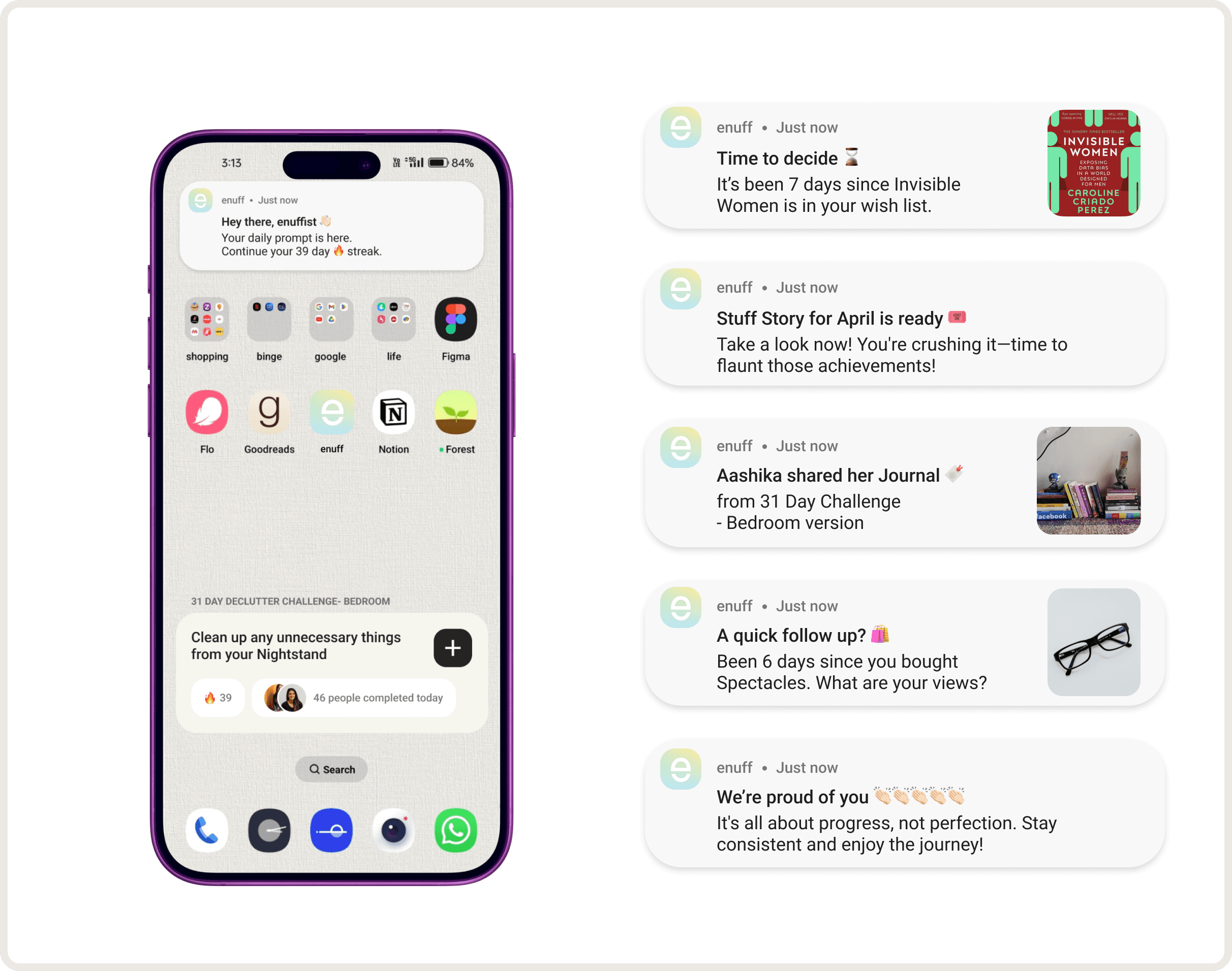
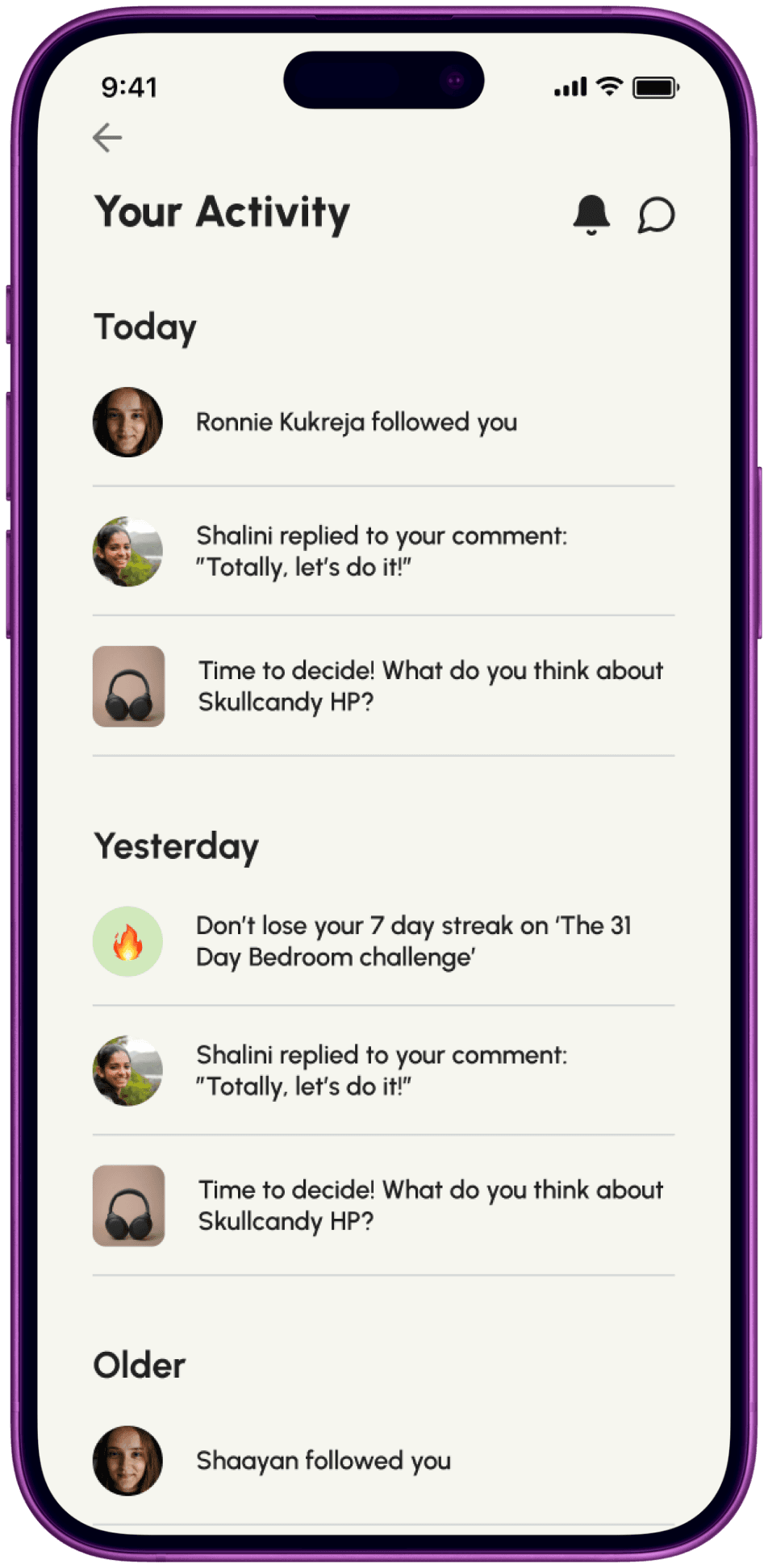
Notifications and Nudges

This journey is full of stepping stones. It’s a change that takes time and is gradual. The app takes care that you are motivated, do not forget deadlines or daily posts.

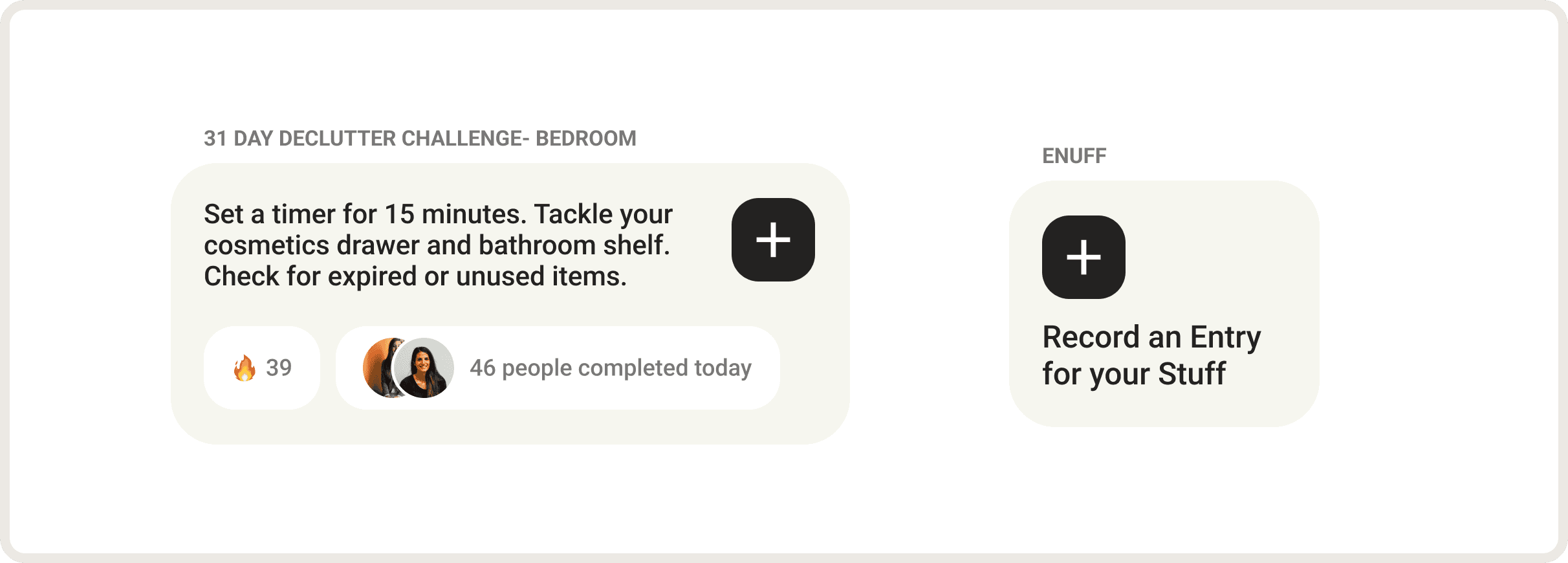
💡 Widgets, to make it easier


The app simplifies adding journal entries and recording items for the Want List. No need to open the app and navigate through it—just place the necessary widget on your home screen for easy access.

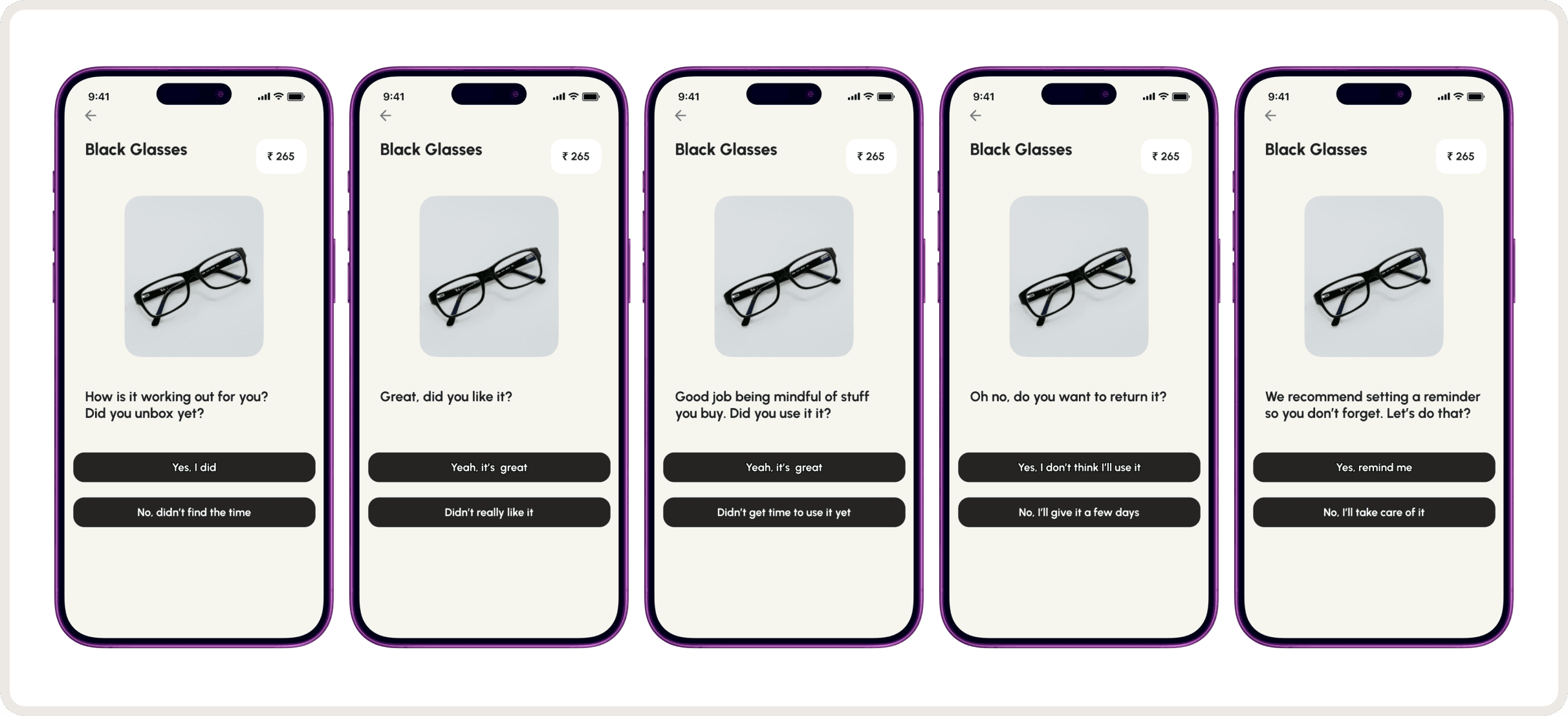
Post buying life of Stuff

Enuff is not just about not buying, or decluttering, it is about using the stuff in your life to their full capacity.


Hence, the app will send the user reminders for things that they have bought too. Did they unbox? Did they use it? You can also set reminders to get a notification to place a return if you didn’t like using something you bought.

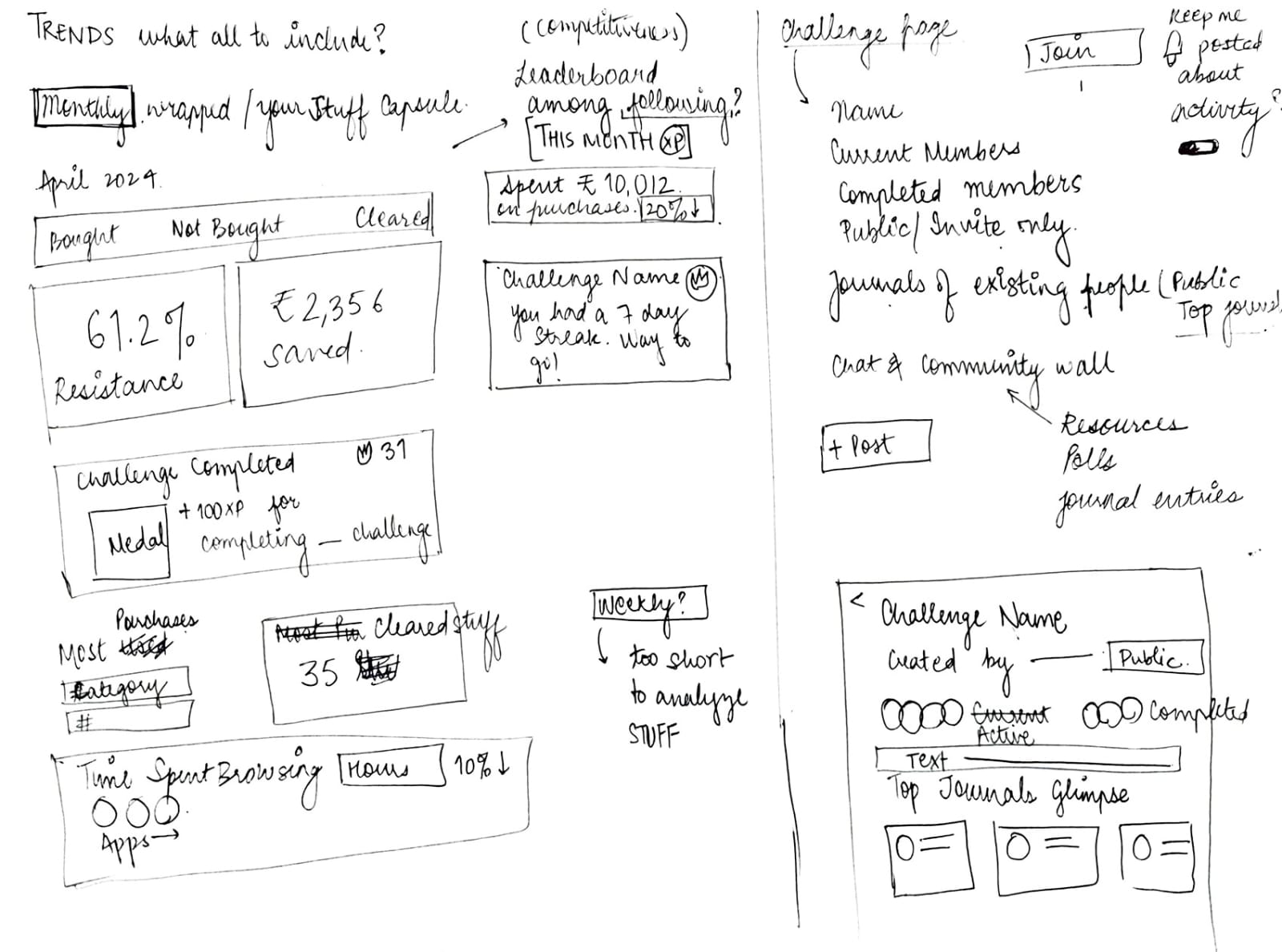
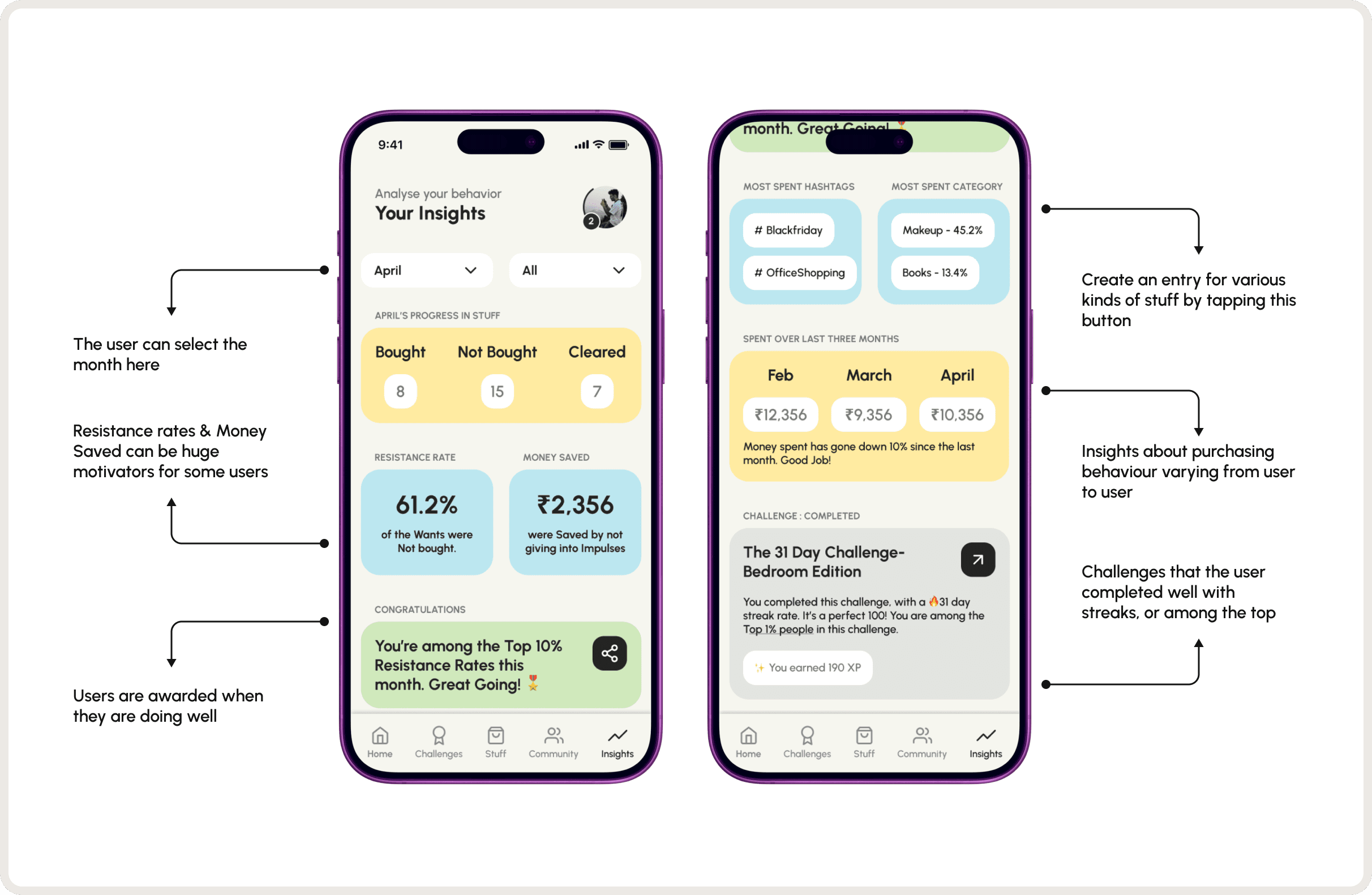
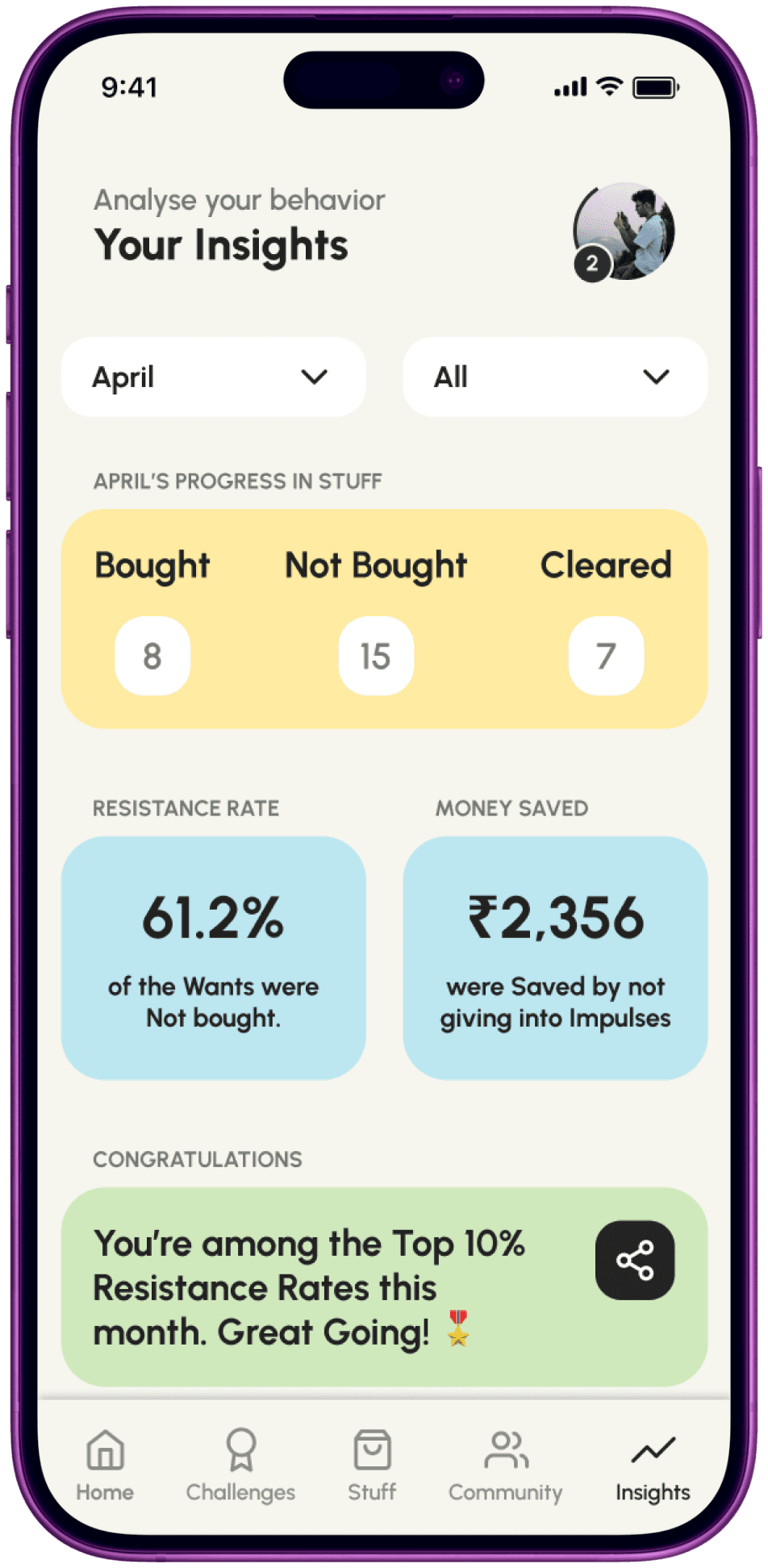
Insights and Behaviour Analysis

It is important to help out beginners be more aware of their purchasing behaviour. This place will analyse their behaviour and help them make the much-needed shift.


A monthly analysis and trend will be available to the user. They can also compare their behaviour over the months and have healthy competitions with other people in the community.


This will keep the energy and motivation high to perform better next month and make their lifestyle better.

Giving stuff Away

For emotional hoarders (like many of us, including myself), saying goodbye to things isn’t easy. However, giving items a nicer farewell can make it easier. That’s why there’s a place to store old memories for remembrance.

Features inside the app impacting behaviours outside the app

Each feature or intervention within the application is designed to foster real-world behavioral change. Here’s how it all connects.

Challenges and Journals

Consistency, Habit Building and Personal Growth

Community Engagement

Motivation, Awareness and Discovery

Updating your Stuff

Mindfulness about purchasing and Letting Go

Reminders and Nudges

Forming patterns on a Subconscious level

Analysing Behaviour

Insights about personal psyche, Better Control

Articles, Polls, Resources

Awareness and Guidance

Offline Events

Social Circle, Lifestyle Movement

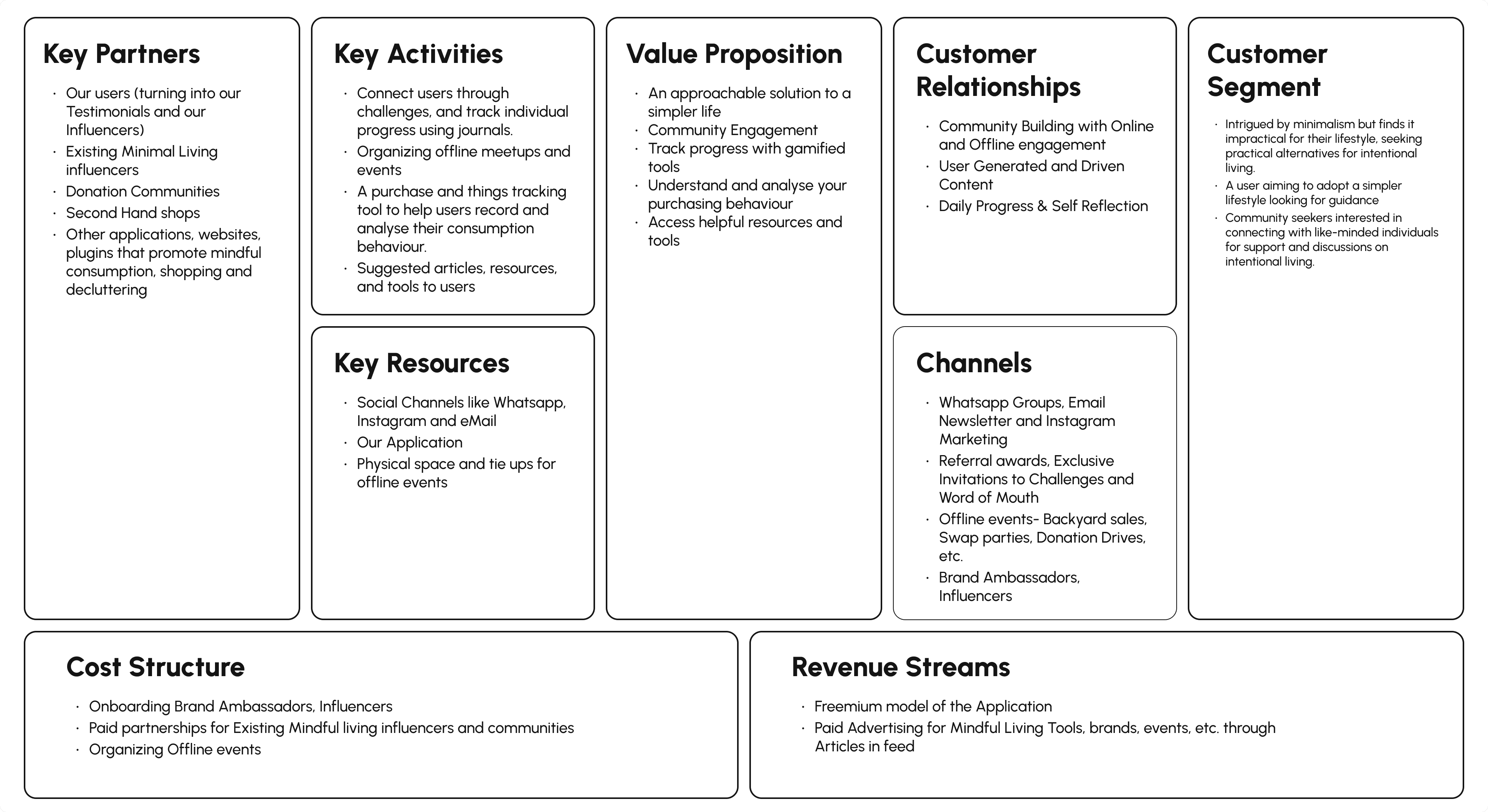
Business Model Canvas

Feedback and Public Reaction

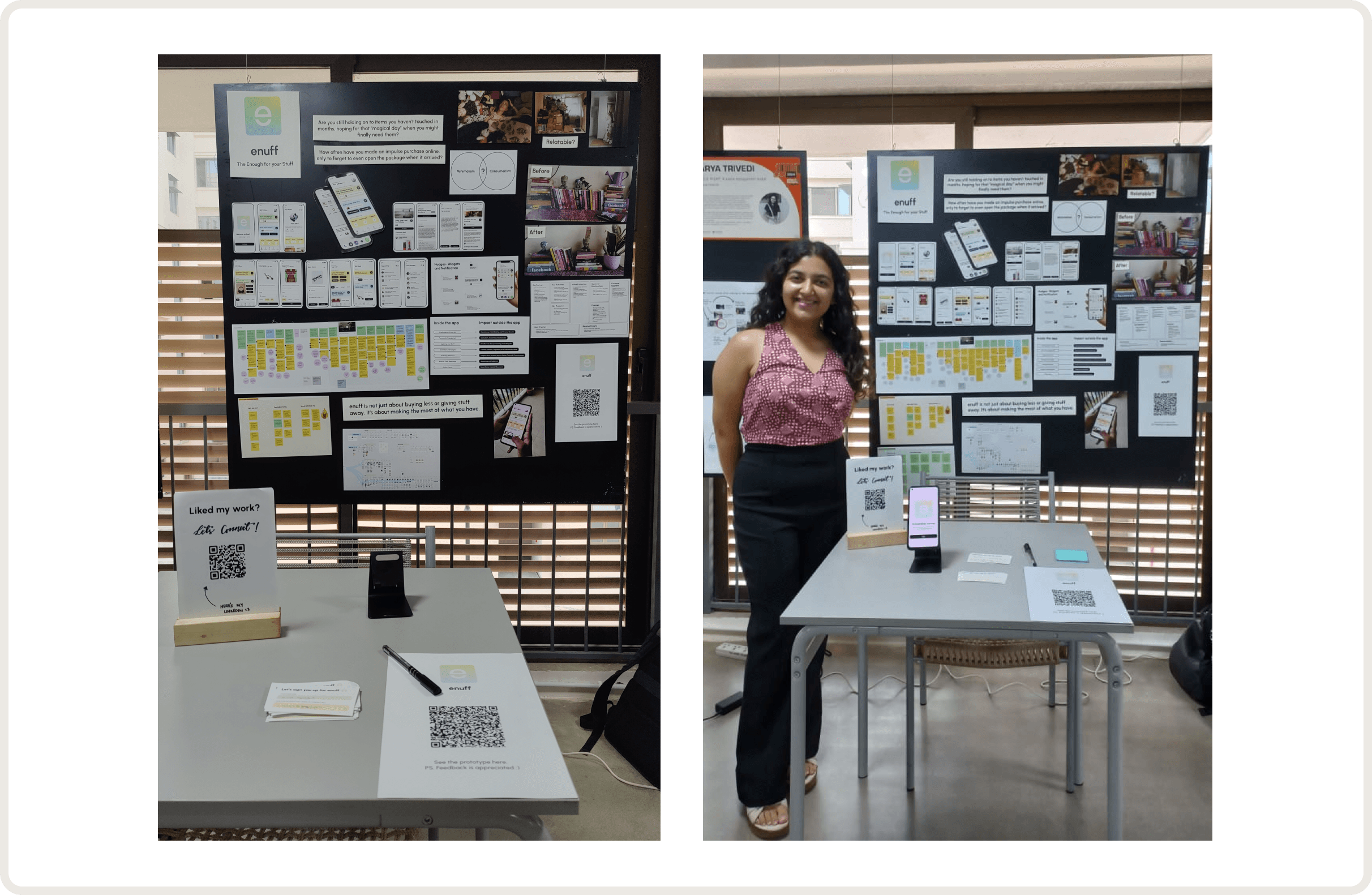
The project received positive feedback from three different jury panels during my internal assessments. I also had the pleasure of presenting my idea to the public at the SMI Graduation Show.

To validate my concept, I invited people to sign up as initial testers for future development.

Reflection and Criticism

Reflecting back on the course of 3 months, it was definitely an amazing journey. This project was among my best work till date.


Although I made a million mistakes, I wouldn’t do anything differently even if I could. Every fall became a learning curve for me, and every stepping stone helped me shape my practice. Through reviews and user testing, I developed future scope for the project.

  • Creating a checker mechanism for ‘If it becomes a social media platfrom, how would you avoid people from faking it?’

  • Working on an ‘All journals’ page

  • Developing strategies for Budgeting and Fundraising

  • Offline events need more planning

  • Developing a ‘Locator feature’ (for finding resources near you)

Liked something you saw? Let’s create amazing experiences for our users together.

Connect

aarushibhalla.work@gmail.com

Follow me

Crafted with care 🥰, a lot of chaos 💫+ a zillion YouTube tutorials + endless cups of cinnamon water 🍵!

© Copyrights 2024 - Aarushi Bhalla

Thank you for Scrolling. Hope you liked what you saw :)

Thank you for Scrolling :)

Liked something you saw? Let’s create amazing experiences for our users together.

Connect

aarushibhalla.work@gmail.com

Follow me

Crafted with care 🥰, a lot of chaos 💫+ a zillion YouTube tutorials + endless cups of cinnamon water 🍵!

© Copyrights 2024 - Aarushi Bhalla

Create a free website with Framer, the website builder loved by startups, designers and agencies.